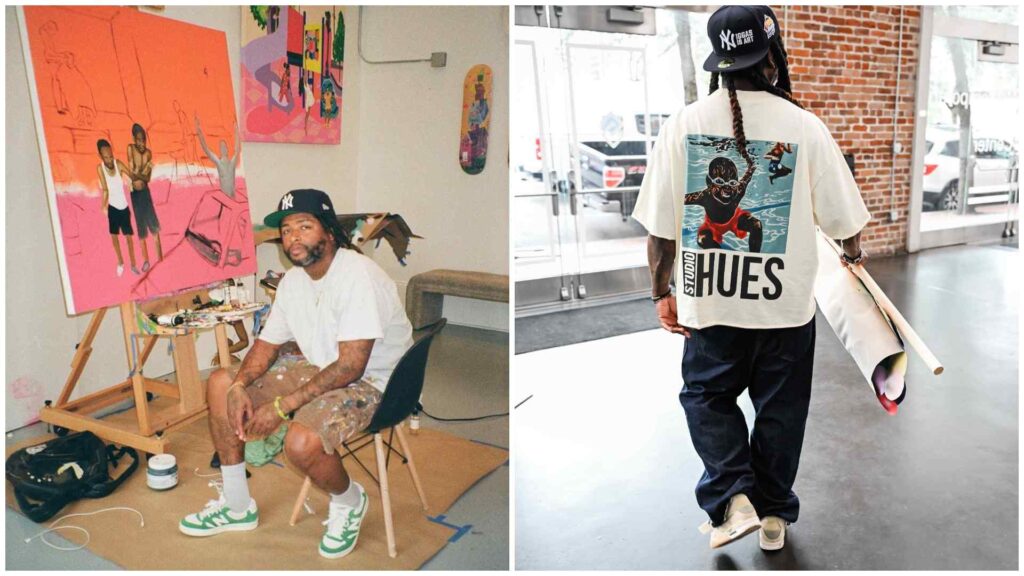
The metropolis of New Orleans means every part to native Jarrad “Jay” McKay, and the artist is declaring his love by way of his exhibition, “Let The Children Play.”
McKay has taken his artwork past gallery partitions and into the neighborhoods that raised him, bringing it on to kids who could not have entry to museums and are sometimes forgotten in conversations about inclusivity and artwork.
With “Let The Children Play,” McKay has reworked neighborhood areas into experiences designed to encourage the following era of artists. Across native parks, rec facilities and neighborhood areas, McKay’s installations invite kids to see themselves mirrored in artwork. His items characteristic imagery of Black kids leaping rope, enjoying with paper planes, and having fun with carefree moments. McKay attracts on the power of the Crescent City, utilizing daring colours, incorporating constructions from its housing tasks, and that includes scenes of second-lines to evoke his childhood nostalgia and honor the cultural legacy of the town and its residents.
McKay’s artwork will be seen all through the town, from murals honoring communities rebuilt after Hurricane Katrina to work that commemorate Black childhood and pleasure. His work has additionally caught the eye of celebrities similar to Erykah Badu and Lil Wayne.
Beyond the streets, McKay’s collaborations with manufacturers similar to Nike, Lululemon and Sneaker Politics have introduced his mission of therapeutic and neighborhood connection by way of creative expression to a broader viewers.
Blavity spoke with McKay concerning the energy of artwork and the way “Let The Children Play” is extra than simply an exhibition; it’s a mirrored image of what occurs when creativity meets goal.
What first impressed the concept for “Let The Children Play,” and the way did your personal childhood in New Orleans play an element in its creation?
Jarrad “Jay” McKay: “For me, rising up in New Orleans within the ’90s and the 2000s, we had been exterior children. That was our social media, that was our outlet. We had been driving bikes, enjoying basketball and enjoying soccer, and out of doors was vigorous. You expertise issues, you be taught issues like having your first battle, studying the way to swim and various things like that. Today, I really feel like the youngsters are jammed up between iPads, social media and expertise a lot that they don’t get exterior to play.”
When you reference ‘bringing artwork to the youngsters,’ what does that imply? What do you hope they see or really feel after they expertise your work in their very own neighborhoods?
“When I speak about bringing artwork to the youngsters, my entire aim was to convey artwork to the neighborhood. These children within the hood don’t get an opportunity to go to galleries or museums. They may even see artwork in school, they might see artwork in historical past books, however a few of these children don’t get an opportunity to attend an artwork present, see Black artwork, or see individuals who appear to be them creating artwork and making a dwelling from it. I met children who like to do artwork and who love to attract and paint. They simply don’t have the assets to do it. So I needed to convey that to them to point out them, ‘Hey, you will be this particular person. You can do it. Art is cool. Art is an expression. Art is a method of expressing your self.’ I wish to expose them to that now so that they’ll have that reminiscence. Like, ‘Oh man, I keep in mind homie coming within the hood. He introduced an exhibition to the precise hood. To our neighborhood.’ I additionally gave out 200 pairs of Adidas sneakers to the youngsters as a result of I felt it was important and wanted. I had children on the market with holes of their footwear, bro, that wanted that. So for me, that was crucial to reveal the youngsters to artwork.”
Your work is filled with coloration and motion. How is that linked not solely to the tales and reminiscences of your personal childhood but in addition to New Orleans as an entire?
“For me, utilizing daring coloration and motion in my items is supposed to point out that New Orleans is a vibrant metropolis. It’s very colourful. We are vibrant individuals. We have nice power. We have nice motion. We second line, we make Mardi Gras Indian costumes and have Mardi Gras. New Orleans is a festive metropolis; it’s nearly like just a little island. The individuals listed below are resilient. The individuals listed below are brilliant. The daring colours symbolize our tradition as an entire. Man, it’s the meals, the custom, and the way Black we’re and the way rooted in tradition we’re. It’s crucial to me to reference that in my items.”
How does your art work incorporate the town’s traditions, similar to its music, parades and historic landmarks?
“As far as custom, in my works, I paint New Orleans from a unique lens. In my items, you’ll see extra of neighborhood nostalgia. You’ll see neighborhoods, you’ll see shotgun homes. I don’t actually replicate on the parades and all that sort of stuff. I do paint landmarks, however for me, it’s neighborhood landmarks. It’s that avenue that you just grew up on. It’s the nook retailer you went into to get your snacks and stuff. So that’s the sort of landmarks I mission onto in relation to custom in my items.”
Why was it vital so that you can take this exhibition past conventional gallery partitions and into the neighborhoods that raised you?
“It was important for me to take this exhibition past the ‘conventional white partitions and the palms behind your again and stroll and go searching’ exhibition. I needed to make this artwork present an expertise. Bring it to the precise playground, to the park, so the work can resonate with what I’m saying. I had children on the market throwing a soccer, driving their bikes. I had blow-up bounce homes, and the youngsters had been on the swings and enjoying on the monkey bars. I needed to create that entire expertise. It was lovely to see these children get out and luxuriate in themselves and play and run. I additionally had them paint this vandalized playhouse. So the youngsters bought to do a paint mission and go away their mark on the playground, too. So it was very important and intentional about avoiding placing this in a up to date house.”
How have residents responded to seeing artwork dropped at life of their neighborhoods?
“Seeing the residents come out and convey their children out … they actually loved it. It was a father who introduced his children on the market and mentioned, ‘Man, thanks a lot for doing this, man. This is gorgeous.’ He was like, ‘I loved myself. The children loved themselves. My children by no means painted on the surface of a home earlier than or bought to depart their mark on something.’ So, the residents beloved it, and the shoe giveaway, all people was so appreciative. We gave out water and PowerAids and stuff like that. The hood actually appreciated it. It was one thing totally different. It was obtained very properly.”
Did you encounter any environmental challenges or political pushback whenever you took your artwork exterior conventional gallery settings?
“I didn’t obtain any environmental challenges once I needed to do that. I collab with NORD, our leisure division right here in New Orleans. I requested for permission, and so they had been tremendous open to the concept and really useful, which was good. They’re all about serving to with the youngsters. NORD does so much for the neighborhood right here and leisure parks and sports activities right here for the youngsters. So thank God I didn’t have any issues with something, no permits, nothing. Everything was clean crusing. Thank God for that.”
Art will be transformative. How do you see this exhibition contributing to long-term neighborhood empowerment or larger entry to the humanities?
Art could be very transformative. There’s no proper or mistaken method to artwork. I inform people who on a regular basis. I see this exhibition going additional. I wish to design a playground round artwork. I wish to design an expertise of a playground scene and play place, simply one thing totally different for youths to expertise artwork, however in a playful method. I wish to design a dope play set. It’s transformative and crucial to convey artwork to children who can’t entry these areas. They simply by no means expertise artwork.
Do you see “Let The Children Play” as the beginning of a brand new method to creating artwork accessible in underserved communities?
Yes, I do see that that is turning into an method for accessible artwork in underserved communities as a result of I’m going to make it my enterprise to convey artwork to these areas and to these neighborhoods that aren’t uncovered. They’ll normally see a mural on the wall, however I wish to convey up to date vibes to them as properly, present them gallery etiquette, and train them the way to observe, categorical and inform how an artwork piece feels to them. I would like them to have the ability to observe and describe the work and be taught the verbiage and language of artwork discuss. So it’s big. I believe it’s crucial.
Are there plans to develop this exhibit to different cities or create new experiences, both alone or with different artists, that target childhood creativity?
I’d like to convey this artwork exhibit all world wide. I’d like to curate, get with different artists in neighborhoods, collaborate with them, and convey their work to mild alongside mine, and we simply make it like an enormous coalition. To give again and to collaborate with artists and are available collectively, not on a contest sort s**t however come collectively and embrace the hood, and make this a factor, man. I wish to go to the roughest of the neighborhoods. I wish to go to the trenches and convey this expertise, this mild, and this positivity to those areas, man. There’s a lot negativity going round on this planet.
About The Author