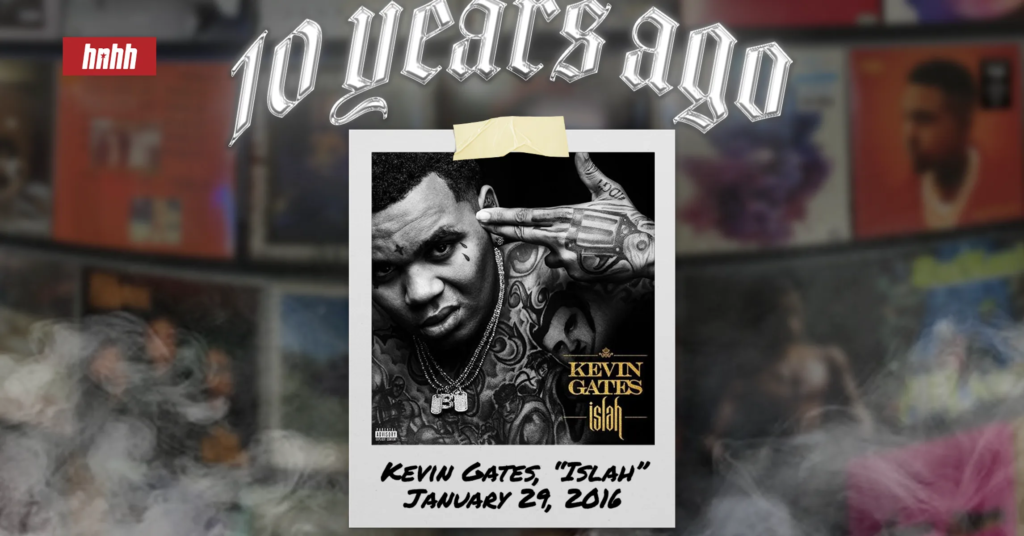
“Islah” Was The Proof Kevin Gates Could Never Be Cancelled
Kevin Gates outsold Adele one time. It’s a random tidbit from the 2010s, however an essential one to be reminded of in 2026. Billboard typically feels arbitrary in hindsight, and Kevin Gates, by some means, has gained a newfound viewers with streamers. But in 2015, Adele emerged with a physique of labor that offered three million-plus copies in its first week with 25. In the months that adopted, it continued pushing higher numbers than most artists pull inside per week nowadays. Mind you, this was nonetheless the early stage of Spotify and Apple Music’s upheaval of music consumption, when folks had been shopping for albums both bodily or digitally.
Then, on January twenty ninth, 2016, Kevin Gates arrived together with his extremely anticipated debut album, Islah. Gates nabbed the No. 2 spot on the Billboard 200 with 112,000 items moved. He misplaced the highest spot to Rihanna’s ANTI, understandably, however nonetheless managed to edge out 25. Perhaps it doesn’t seem to be the most important feat contemplating Adele was greater than two months faraway from her album’s launch, however 25 nonetheless had a grip on the world in the identical manner we now contextualize the industrial feats of Taylor Swift’s newest albums. Gates, in the meantime, had been working independently as much as that time, cultivating a loyal fanbase that stretched from the trenches of Louisiana to the editorial workplaces of Pitchfork and past by mixtape benefit, avenue hustle, and a fancy persona that romanticized the shadows he existed in whereas praying for the sunshine.
That dichotomy, wrestle, and resilience in the identical breath, is the commonality Gates shares with somebody like Adele. They could be worlds aside geographically and culturally, but emotionally, they tugged on comparable heartstrings. Adele beautified the ugliest moments of heartbreak and made them common. The highs and lows of therapeutic emotional scars bled onto a stunning terrain of melody.
ATLANTA, GA – JUNE 18: Rapper Kevin Gates performs onstage at Hot 107.9 Birthday Bash at Philips Arena on June 18, 2016 in Atlanta, Georgia. (Photo by Paras Griffin/Getty Images)
The emotional journey Kevin Gates explores on Islah isn’t linear by any means. The lust of “One Thing” evolves into the exploitation of “Ain’t Too Hard,” and by the point “Not The Only One” hits, the album’s emotional thesis sharpens: loyalty is fatalistic. The streets that cultivated his sound, legacy, and assist base each floor him and inspire his need to flee them. That emotional authority, the power to articulate ache in a manner that feels survivable, is what Gates shares with Adele, and it exhibits in public consumption. Albums that condense such a broad vary of feelings right into a concise tracklist succeed not merely due to attractive melodies, infectious hooks, or viral-ready one-liners, however as a result of the uncooked honesty beneath resonates deepest.
That vulnerability, although, isn’t unique to Kevin Gates’ pen. More than something, it’s embedded within the quirks inside every bar and admission that observe a long-standing Southern custom, particularly, in Louisiana. Gates’ influences are broad. His emotive supply can really feel as touching as Adele’s, whereas his technical precision and vivid storytelling carry remnants of early Eminem. However, he stays tightly aligned with a Southern lineage inherited from Boosie’s emotional confessions. “Told Me” spiritualizes hardship with grueling admissions of dependancy and suicidal ideation, leading to one of many album’s most heart-wrenching moments. It’s a blueprint that has carried by the youthful technology that adopted him.
It’s laborious to not see Gates’ DNA in artists like NBA YoungBoy or Rod Wave, each of whom have cultivated equally devoted fanbases who see themselves within the unpolished ache they current. They every possess ethical contradictions inside their emotional vulnerability that aren’t supposed to garner public validation. NBA YoungBoy internalizes it. Rod Wave romanticizes it. Like Kevin Gates, each supply a window right into a Southern masculinity that refuses to apologize for feeling.
Whether it’s the tears that observe loss or the fury that fuels protection when the chances aren’t favorable, that unapologetic emotional posture is exactly how Kevin Gates has sustained a profession by controversy and turmoil. At instances, it broke social stigmas. Gates deserves extra credit score than he’s given for a way overtly he mentioned intercourse in ways in which made many uncomfortable and, ultimately, normalized it. Other instances, although, it felt like he crossed indefensible traces.
After releasing “Kno One” because the venture’s first single, Gates doubled again later with “The Truth,” addressing the viral incident through which he kicked a woman in the chest throughout a live performance in Florida. The jarring video circulated throughout WorldStarHipHop and practically each main hip-hop weblog instantly afterward. Gates claimed self-defense underneath Florida’s Stand Your Ground law, and “The Truth” offered a perspective that didn’t win him many favors. The incident in the end led to his incarceration and have become a centerpiece in a string of authorized points he confronted throughout that interval. Yet “The Truth” nonetheless felt quintessentially Gates. He refused to keep away from the controversy or gloss over the nuance that cellphone footage couldn’t seize. He defined that he had warned the lady, who he claimed continued to sexually assault him. Even then, Gates zoomed out by a religious lens, rapping, “Father forgive me I fucked up a blessin’ / Whenever I fall you the one one to catch me.”
The public fuck-ups are deeply human, simply as a lot as leaning on religion to maneuver by them. That expectation of honesty over purity is exactly why Gates has translated so seamlessly into the streaming period. Platforms reward immediacy and emotional transparency, not polish, and Gates’ catalog already functioned that manner lengthy earlier than TikTok or Twitch determined what mattered. Streamers inside the Kai Cenat orbit, Duke Dennis, Reggie, and even the barely-out-of-her-teens Yonna Jay, have leveraged Gates’ catalog for viral moments. It’s not unusual to listen to Duke Dennis singing alongside to a Gates file, Reggie strolling right into a room crooning “Satellite, by no means actually made love,” or Yonna reenacting the Bobbi Althoff meme whereas confessing she’s one among his greatest followers. That visibility hasn’t simply prolonged the shelf lifetime of Gates’ again catalog. It’s allowed newer tasks, much less commercially dominant than Islah, to nonetheless discover extensive audiences.
Frankly, as a rapper who maximized his profession by a blueprint of independence that his dwelling state perfected with labels like No Limit and Cash Money, Gates’ authenticity is what’s allowed him to endure. Even whereas dealing with a battery cost after the Florida incident, songs like “2 Phones” have been cemented into the pop-cultural lexicon, whereas “Really Really” stays anthemic a decade later. More than something, it speaks to how Islah, after years of impartial groundwork, penetrated the mainstream with out sacrificing musical id. That understanding has turned Kevin Gates into an establishment of kinds. His fanbase sheds and regrows like snakeskin, evolving, however by no means disappearing.
That’s the factor: Gates’ viewers by no means required him to be morally clear, solely emotionally trustworthy, and Islah stays the clearest articulation of that philosophy. It codified a Southern masculinity that allowed contradiction to coexist with vulnerability, religion to take a seat beside violence, and accountability to stay imperfect. That framework didn’t simply maintain Kevin Gates. It quietly turned a template. You can hear it in NBA YoungBoy’s isolationism, Rod Wave’s romanticized despair, and in how youthful audiences gravitate towards artists who really feel emotionally legible even when ethically difficult, like XXXTENTACION or Kodak Black. Islah labored as a result of Gates allowed emotional rawness, religious battle, and unapologetic flaws to coexist after which transmit throughout generations. In that sense, dethroning Adele’s 25 alongside Rihanna wasn’t an business anomaly, however the results of vulnerability translated with out flinching, filtered by a Southern, masculine, and uncompromising lens.
About The Author