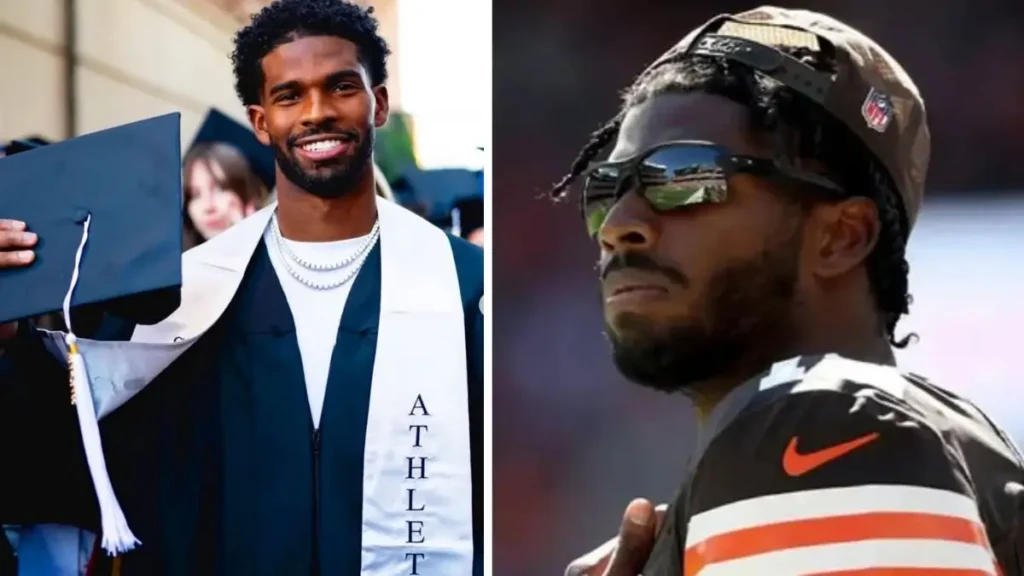
By Andre Coleman, PowerVault Staff
Shedeur Sanders, son of the legendary Deion Sanders, has once again defied the odds and captured the spotlight—not just for his prowess on the field but for graduating college just one year after taking a gamble on the NFL Draft. In a world where young Black athletes often face scrutiny and pressure to choose between education and professional sports, Shedeur stands as a testament to the power of excellence, an embodiment of the notion that success doesn’t have to come at the expense of intellect.
To understand the significance of this moment, we must first acknowledge the legacy of both Shedeur and his father. Deion Sanders, one of the most electrifying athletes in history, made waves as both a football and baseball player, but he also broke barriers with his unyielding confidence and charisma. Shedeur, following in those monumental footsteps, has not only inherited talent but also the weight of expectation. In an era where athletes are often pushed to prioritize immediate financial gain over academic achievement, Shedeur’s decision to finish his degree is a bold declaration that education remains a vital part of the Black experience, especially in sports.
Shedeur’s journey speaks volumes about the cultural renaissance within the Black community, where excellence in multiple arenas is increasingly celebrated. His graduation amidst the backdrop of NFL aspirations highlights the importance of versatility and resilience, embodying a narrative that many young Black men and women can relate to. It is more than just a personal achievement; Shedeur has become a symbol of redefining what success looks like—one that includes intellectual growth alongside athletic accomplishments. This is a much-needed counter-narrative in a society that often seeks to pigeonhole Black youth into stereotypes based on their chosen paths.
Reflecting on past moments, we can draw parallels to figures like Chadwick Boseman, who balanced education and success in the film industry before becoming a household name. Just as Boseman used his platform to advocate for Black representation and excellence, Shedeur is wielding his spotlight to challenge preconceived notions about athletes’ roles in society. His accomplishment serves as an inspiration, a reminder that pursuing multiple passions can lead to boundless opportunities and that the idea of “dual-threat” is about more than just sports—it’s about thriving in life.
As we look to the future, Shedeur Sanders’ story is far from over. With the NFL Draft now behind him and a college degree in hand, all eyes will be on how he navigates the professional landscape. Will he continue to prioritize education and community engagement alongside a demanding career? The possibilities are endless. What remains certain is that his journey will inspire the next generation to pursue excellence—not just in sports, but in all facets of life. In a world that often tries to narrow our focus, Shedeur’s narrative boldly proclaims that we can be exceptional in everything we choose to embrace.
About The Author