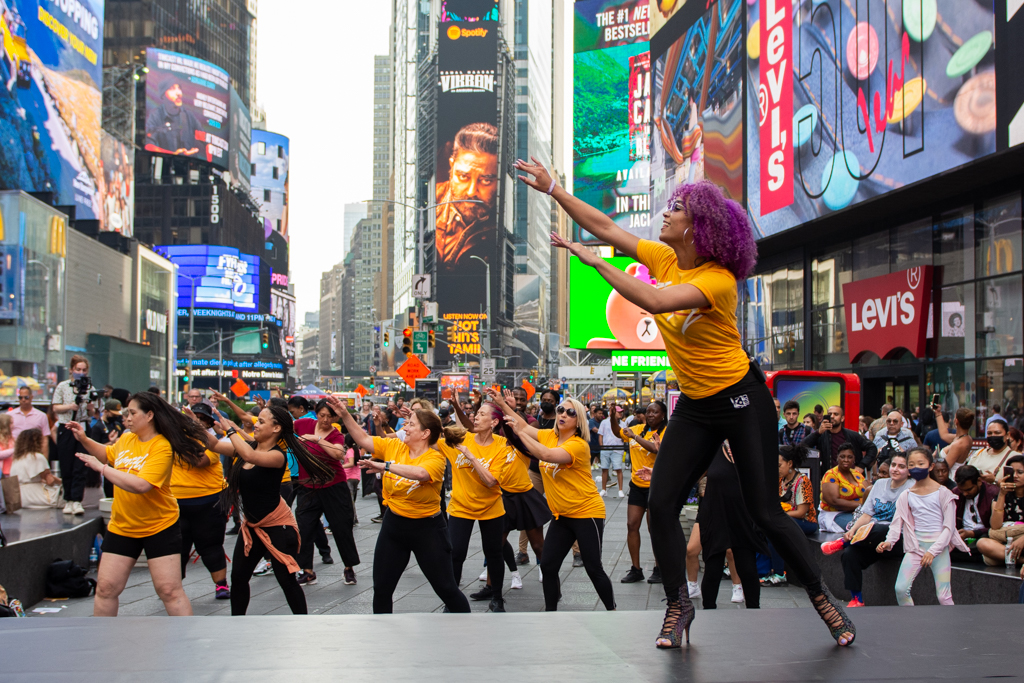
The Alvin Ailey American Dance Theater’s vacation season is underway at New York City Center by Jan. 4.
This season marks extra than simply one other yr of the inventive phenomenon that makes use of dance as a catalyst for non secular and cultural expression. It additionally marks the daybreak of a brand new chapter beneath the steerage of Artistic Director Alicia Graf Mack, whose inaugural season embraces each the corporate’s foundational Black roots and its evolving dedication to variety, now together with the Afro-Latino diaspora.
Founded in 1958 by revolutionary dancer and choreographer Alvin Ailey, the Alvin Ailey American Dance Theater was created as a protected house for Black dancers who have been denied entry and alternatives at different establishments. Over time, performances comparable to Revelations, a celebration of African American heritage, Cry, choreographed by Ailey to honor Black ladies in every single place, and Masekela Langage, a chunk that drew parallels between apartheid and racial injustice, made the dance firm a worldwide pressure.
Alvin Ailey turned recognized for utilizing inventive freedom to have a good time African American identification whereas not shying away from the controversial matters of identification and belonging.
Today, the corporate has expanded its intersectional imaginative and prescient to incorporate Afro-Caribbean and Latin dance. Afro-Brazilian dancer Dandara Veiga discovered her approach from The Ailey School to the ensemble after seeing performers who seemed like her. Bronx-born Sebastian Garcia, of Afro-Dominican descent, discovered his introduction to bop by AileyCamp. This academic summer season program gave him an early sense of belonging and a artistic voice. Instructor Katherine Jiménez, an Afro-Latina Mambo instructor with the Ailey Extension, is fostering the rhythm of cultural fusion in movement, making Afro-Caribbean and Latin kinds approachable for newcomers and veterans alike. For her, the Mambo is greater than music and mixture steps; it’s a dialog between African heritage and historical past.
Blavity spoke with the creatives in regards to the delight they’ve in bringing their heritage to life on stage.
Blavity: What do you assume impressed the Alvin Ailey firm’s imaginative and prescient to embrace and have a good time Latino communities by efficiency and training?
Dandara Veiga: Mr. Ailey’s legacy is all about celebrating variety —sharing his personal tradition whereas studying from others, together with Latinx communities. His quote, “Dance got here from the folks and may all the time be delivered again to the folks,” completely displays this. During the Edges of Ailey exhibition on the Whitney, seeing his travels to Brazil and his engagement with Afro-Brazilian tradition made me really feel honored to be a part of his persevering with legacy.
Katherine Jiménez: Ailey has all the time embraced a worldwide imaginative and prescient, one which celebrates the African diaspora in all its kinds, together with the deep connections to Latin and Caribbean cultures. From its beginnings, Ailey’s mission has been rooted in representing the fullness of the human expertise, and that naturally contains Afro-Latin voices, rhythms and tales. The Ailey neighborhood has all the time been inclusive of Afro-Latin tradition, recognizing that our histories and dances are interconnected.
In what methods do you’re feeling Ailey’s mission of “bringing dance again to the folks” has resonated with Afro-Latino audiences, dancers and choreographers?
DV: His work speaks universally by motion, rhythm, storytelling and expression. These components join throughout cultures and resonate deeply with Afro-Latino communities, reflecting our heritage, rhythm and vitality. There are components that deeply resonate with me personally and produce again recollections of my upbringing. For instance, sure actions in some ballets remind me of dances that honor the orixás in Yoruba tradition — traditions which can be very a lot alive in Brazil and have been introduced by enslaved Africans generations in the past. Even in Revelations, the colours, the costumes, and a number of the actions in sections like “Procession” and “Wade within the Water” evoke, in my eyes, a robust connection to Afro-Latin tradition. Similarly, in Grace by Ronald Okay. Brown, the physicality and spirit of the choreography typically remind me of Afro-Cuban dance and gestures that mirror the Yoruba orixás. I wish to be clear that that is how I join personally — by my background and perspective as an Afro-Brazilian girl, I see and really feel these cultural echoes throughout the motion.
KJ: That mission resonates deeply as a result of it honors the place we come from, our traditions, our music, our pleasure. Afro-Latino communities perceive dance as a part of on a regular basis life, not simply efficiency. Ailey’s strategy mirrors that perception by opening doorways for folks from all walks of life to seek out themselves within the motion. Whether you’re within the viewers or on the dance ground, you’re feeling seen.
Sebastian Garcia: Alvin Ailey’s work typically faucets into what it means to be human by dance. When audiences see the corporate, they will simply see themselves mirrored on stage by its dancers, the costumes or the story. The firm acknowledges Afro-Latinx audiences by the choreographers it collaborates with. This season, the corporate will carry out a ballet by Maija García titled Jazz Island. The ballet brings to life a Caribbean folks story impressed by Geoffrey Holder’s written work, Black Gods, Green Islands, with music composed by Etienne Charles. Throughout your entire fee, Maija was very adamant about involving your entire firm in conversations about Caribbean folks tales, rituals, life, and the way we, as an entire, may come collectively to inform this story respectfully. This degree of care lets a neighborhood just like the Afro-Latinx neighborhood know they’re seen and valued as vital contributors to the humanities.
What affect has illustration by dancers from Latin America and the Caribbean had on the corporate’s attain and relationship with these areas?
DV: Representation has been very important. Touring nationally and internationally with neighborhood workshops permits Ailey to attach immediately with audiences. Programs like The Ailey School auditions overseas give dancers like me the possibility to pursue coaching and careers that have been as soon as goals. I’ve observed an amazing affect since touring as a member of the corporate. Many Latinx artists and college students have reached out to Leonardo Brito and me, celebrating our presence within the first firm and expressing new pleasure about Ailey. It’s been so heartwarming to witness. From the analysis Leonardo and I’ve finished, for the reason that firm’s founding, the one Brazilian artist who labored immediately with Mr. Ailey throughout his lifetime was Ismael Ivo — an influential determine in Brazil’s dance business. To our information, Leo and I are the primary Brazilians to hitch the principle firm since then, and we are able to’t specific how a lot of an honor that’s. We actually stay up for performing with the corporate in Brazil sometime, to have a good time that second carefully with our family members within the viewers. It fills me with delight and emotion to see extra Latin college students at The Ailey School right now. When I first joined the college in 2016, I didn’t communicate English, so I perceive how difficult it may be to adapt and belong. That’s why it’s so vital to construct connections, raise one another up and present that this dream is feasible.
KJ: Representation builds bridges. Seeing dancers from the Caribbean and Latin America mirrored on stage invitations audiences from those self same communities to really feel a way of belonging. It additionally strengthens Ailey’s world relationships, reminding everybody that dance is a shared language that connects us throughout borders.
SG: Alvin Ailey is a really various dance firm, from the dancers to the inventive workers. This degree of variety typically opened up a approach for Ailey to be concerned in a number of Latin American/Caribbean areas. One affect Alvin Ailey has had is its capability to supply open lessons to the general public. Ailey presents a number of Latinx and Caribbean conventional dance kinds taught by professionals by its Ailey Extension program. Regarding how the illustration has impacted me on a private degree, after I was first listening to about Alvin Ailey as a pupil, two dancers I admired have been Linda Celeste Sims and Belen Pereyra. Both dancers, whereas technically and artistically proficient, had cultural lineage from the Dominican Republic. I’m a first-generation American Dominican, so to see that different Dominicans have been being proven in such a creative mild at such a excessive caliber was very motivational. Now that I’m within the firm, it’s good to know that my journey began partly as a result of I noticed what I may grow to be by illustration.

How does it really feel to be a part of an organization that so deliberately merged cultures by dance?
DV: I really feel honored and grateful. As an Afro-Latina from a small city in Brazil, I started ballet at 13 and looked for dancers who seemed like me. Through Ailey, I discovered a spot the place dance turned my language, my expression, and my strategy to belong. I had the chance to increase my coaching in different international locations earlier than becoming a member of Ailey, however there’s something very particular about being a part of this group—it permits me to proceed that journey with a real sense of belonging.
KJ: It feels highly effective and deeply private. The Ailey legacy gave me the inspiration to seek out my very own voice as an artist and educator. But I additionally acknowledged that Afro-Caribbean dances, like Mambo, Pachanga, Cha Cha, and Boogaloo, weren’t a part of the formal strategies I educated in at The Ailey School. About ten years in the past, I started implementing these strategies in my lessons by the Ailey Extension. It’s been an honor to introduce and develop these kinds inside an establishment that values inclusion and authenticity. That integration is historic for me as a result of it bridges the cultural experiences that formed who I’m with the legacy of Ailey’s mission.
SG: I really feel very blessed to be a part of an organization that’s so closely diversified. In the studio, I’m consistently studying one thing new from my fellow colleagues. This retains me curious and humbled. We typically stay in a world the place vanity comes because of not interacting with people who find themselves completely different from us. Working for a extremely various firm offers me the chance to study new abilities from everybody I meet.
Dandara, you first entered the Ailey neighborhood by The Ailey School. What do you assume makes this coaching setting significantly inclusive and welcoming to Afro-Latino college students?
DV: It’s the legacy of Mr. Ailey and the neighborhood that carries it. His reminder that “dance got here from the folks” creates an area the place Latinx dancers really feel seen, valued and inspired. For me, probably the most highly effective a part of coaching at The Ailey School was being in a room surrounded by extremely gifted academics and colleagues who seemed like me. That gave me a type of assurance that what I used to be pursuing —although tough and demanding — was not unimaginable. I used to be very shy after I arrived and didn’t communicate English on the time, so I realized by observing. Not everybody realized that my quietness got here from a language barrier, however regardless of that, I all the time felt included. My academics took the time to attach past phrases — by vitality, gestures and endurance. They corrected me, inspired me and helped me discover my voice by motion. There was an actual sense of care within the studio. That setting allowed me to learn to perceive and specific myself past language, and that’s what made me really feel actually seen and valued.
The Afro-Brazilian neighborhood has a number of dance kinds with African roots, comparable to Samba and Capoeira. Are these, or another kinds, built-in into your routines at Ailey to display the bridging of cultures bodily?
DV: Yes, I completely see these dance kinds in a number of items we carry out. Many of the corporate’s works have a good time motion traditions from throughout the African diaspora and the Americas, and Maija Garcia’s Jazz Island is an excellent instance of that. In Jazz Island, there’s even a “Goddess” character that, to me, evokes the spirit of the Yoruba orixás and Afro-Cuban motion. The music, rhythm and emotional vitality of the piece additionally carry a deep Afro-Latin connection in my eyes. It seems like a celebration of that shared heritage and the enjoyment that comes from it. The group additionally presents lessons and workshops for the general public in kinds together with Afro-Cuban, salsa, Zumba, and different Latin American influences by Ailey Extension. These kinds bodily mirror the cultural bridging that Ailey embodies.
Katherine, like AileyCamp, the Ailey Extension has made dance training accessible past skilled coaching, which might be daunting for learners. How do you make sure you’re introducing folks to the cultural roots and affect of the dances whereas preserving it enjoyable and straightforward to study?
KJ: I strategy each class with intention and pleasure. I imagine that when folks perceive the place a dance comes from, its rhythm, its folks, its function, they transfer in another way. So whereas I break down advanced patterns in easy methods, I’m all the time giving cultural context. I make certain my college students really feel the connection to the roots whereas having enjoyable within the course of. That steadiness of training and pleasure is what makes dance transformative.
Over the years, how has the Ailey Extension bolstered the concept dance is not only efficiency however neighborhood expression?
KJ: The Ailey Extension is a neighborhood in movement. It’s the place folks of all ages, backgrounds and ranges come collectively to share house, vitality and pleasure. You see friendships kind, confidence develop and tradition celebrated. Dance turns into greater than choreography; it turns into a language of connection and belonging.
You additionally entered the Ailey neighborhood by The Ailey School. What do you assume makes this coaching setting significantly inclusive and welcoming to Afro-Latino college students?
KJ: As an “Ailey baby,” the Ailey School has actually been my residence for the reason that starting of my dance journey. It’s the place I’ve all the time felt welcome, highly effective and deeply related to my ancestors. The Ailey School embraces variety at its core; it’s an setting that encourages you to deliver your entire self into the room: your heritage, your story, your individuality. That type of inclusivity permits Afro-Latino college students like myself to see ourselves mirrored within the artistry and within the broader cultural dialogue that Ailey represents. It’s a spot the place your background isn’t simply accepted, it’s celebrated.

Sebastian, the AileyCamp allowed you to immerse your self in dance at an age when it might have been inaccessible to some. How do you’re feeling the camp is breaking limitations for dance as an outlet for Black and Latino youth?
SG: AileyCamp was such a significant place for me and my upbringing as a dancer. The camp, which is a part of Ailey Arts In Education & Community Programs, presents at-risk youngsters in main cities a strategy to attain their full potential by dance. In this point in time, plenty of Afro-Latinx youth aren’t given the healthiest areas to specific themselves, particularly if they’re first-generation Americans. AileyCamp presents children position fashions whom they will relate to and workshops the place children study useful instruments to be a kinder, extra assured particular person. The camp additionally does an excellent job of giving children the house to be children whereas additionally educating them about private improvement by the humanities. As a camper, I realized the way to really feel assured in my very own pores and skin and talk my feelings successfully.
What classes from AileyCamp’s community-centered strategy do you carry with you as a performer within the firm right now?
SG: As an AileyCamper, one lesson I realized was to by no means quit on what I’m focused on doing. Throughout this system, your entire camp would begin its mornings by reciting an inventory of affirmations. At the time, I didn’t know why or the affect this may have on me as an individual till this system was over. What these affirmations did was instill in all of us a type of confidence to tackle the world and a degree of belief in our personal skills. One affirmation I all the time remembered was our final one, which learn, “I can’t use the phrase can’t to seek out my prospects.” This is a really highly effective affirmation as a result of it debunks the concept of not with the ability to do one thing from one’s thoughts. This thought is such a robust factor, particularly for Afro-Latinx youth. So typically, Afro-Latinx youth are reminded of what they will’t do on this world. This affirmation reminds them of their value and propels them to do extra.
About The Author