50 Cent and Courtney Kemp: Who Gets Power’s Credit?
By Marcus Ellison, PowerVault Staff 50 Cent revived his Power dispute with Courtney Kemp after Omari Hardwick addressed claims that she wanted Ghost written out early. His latest message included a pointed declaration...
Advertisement

By Marcus Ellison, PowerVault Staff
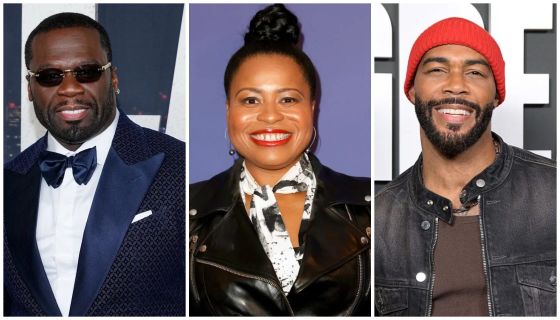
50 Cent revived his Power dispute with Courtney Kemp after Omari Hardwick addressed claims that she wanted Ghost written out early. His latest message included a pointed declaration: “She forgot I hired her.” That is a claim about hierarchy, not proof of how every creative decision happened. Hardwick, meanwhile, acknowledged tension without signing onto either side’s account. The distinction matters because a conversation about one beloved character has become a fight over who gets to claim the franchise. With multiple spinoffs keeping that television universe alive, this is also an argument over whose contributions stay attached to its success. Ghost may be gone, but the struggle over Power’s legacy clearly has fresh episodes left.
During an Associated Press interview, Hardwick was asked about 50’s allegation that Kemp wanted his character removed earlier. “There was definitely a shift,” he said. “Oftentimes the most talented people are treated not necessarily the greatest.” Those words describe his experience, but they do not confirm a proposed season, a script decision or Kemp’s intent. Asked about his public silence, Hardwick responded, “I never said anything, did I?” The interviewer agreed: “No, you didn’t.” That exchange matters before anybody starts assigning him a team. He later added, “I always rock with 50. I always pray for Courtney.” Diplomatic? Absolutely. An endorsement of every accusation circulating around his former workplace? That would be doing entirely too much with the available evidence.
The dispute gained fresh attention after 50’s October interview with Variety, where he challenged Kemp’s account of their contributions and claimed she wanted Ghost killed off by Season 3. He accused her of taking too much credit while positioning himself as instrumental to the franchise’s expansion. Kemp disputed his description of their working relationship. She acknowledged his role in bringing Power to television while emphasizing that she created and wrote it. After Hardwick’s AP comments, 50 reposted the interview clip on X and returned to the hiring claim. He also wrote, “we hit the bullseye with POWER.” His message did not tag Kemp, although the wording appeared directed at her. The post below shows how Hardwick’s measured answer became fuel for 50’s argument.
That post pairs Hardwick’s words with 50’s interpretation, and those are two different things. A repost can make one person’s careful answer look like another person’s receipt. Here, Hardwick did not say Kemp tried to remove him during Season 3. Nor did he settle who deserves the largest share of Power’s success. The reporting supplied for this story includes no script drafts or production correspondence establishing that alleged plan. Kemp has not publicly answered Hardwick’s comments or 50’s latest post, according to the source account. Her silence on this round cannot fairly be counted as agreement. Until more evidence appears, the early exit claim remains 50’s allegation, not a settled production fact.
Hardwick’s history with 50 also complicates any easy picture of two men united against Kemp. Their relationship has had its own friction, including public disagreement over Hardwick’s value to the franchise. During a 2022 appearance on The Pivot podcast, Hardwick said he earned $150,000 per episode and believed that underpaid his importance to STARZ. That figure is his account of his compensation, not a full accounting of his contract. It cannot establish what bonuses, rights or other terms existed. Still, it explains why his recent restraint deserves attention: he knows what being publicly evaluated by a former collaborator feels like. Keep that distinction in mind when watching the video below.
The video should be considered alongside the reporting, not treated as the complete production record. Power premiered in 2014 and ended its original run in 2020. Power Book II: Ghost followed in 2020, Raising Kanan arrived in 2021, and Force launched in 2022. That expansion helps explain why credit remains valuable long after the original finale. Every new entry introduces another audience to a world whose foundation was built through several kinds of Black talent, not one interchangeable contribution. Kemp’s writing and series creation, 50’s producing and promotional work, and Hardwick’s performance served different functions. None can simply replace the others. Black television history offers a useful comparison: Mara Brock Akil created Girlfriends in 2000, while its ensemble made those characters beloved. Naming the creator never required pretending the performers did not matter. Power deserves that same basic clarity.
The real test is whether success creates room for everybody or becomes one person’s property.
Gratitude is not a lifetime contract to accept somebody else’s version of your contribution.
Hardwick deserves room to describe disappointment without being drafted into somebody else’s feud. His answer recognizes a relationship with 50 and keeps a measure of distance from the fight. That is a reasonable choice for an actor whose most recognizable role still follows him into interviews. His own past friction with 50 makes that restraint more meaningful than a convenient show of allegiance. Fans can want a sharper answer, but access to a performer does not create ownership of his grievances. He also should not need to perform hostility toward Kemp to prove loyalty to 50. Gratitude is not a lifetime contract to accept somebody else’s version of your contribution. Hardwick can value the opportunity, question the treatment and decline the public showdown. Those positions can exist together without canceling each other out.
The industry argument needs better vocabulary than who hired whom. Television credits distinguish creating, writing, producing, performing and distributing because those jobs carry different responsibilities. A person can help get a show sold without having written its central characters. Another can create those characters without being solely responsible for the show reaching viewers. Actual authority depends on agreements and production structures, not the confidence of a social caption. Publicity can sell a clean origin story; collaborative television rarely fits neatly inside one person’s victory speech. The credit question also runs through PVN’s coverage of the Stanky Legg’s return and who gets recognized. Different business, familiar pressure point: visibility can overwhelm the record of who built what. The answer should come from documented work, not whoever has the loudest promotional voice.
Fans have a responsibility here, too. Loving Ghost does not establish what happened inside a writers’ room, and enjoying 50’s humor does not make his version automatically complete. The funniest caption often travels farther than the careful correction. That rewards certainty even when the receipts stop short. A clipped interview also loses the questions and pauses that help explain what somebody actually agreed to. Nobody needs to abandon the group chat; the standard simply needs to improve. Ask what was said directly, what was inferred and what remains disputed. PVN’s coverage of Faith Evans and Biggie’s estate invites a related discipline: keep distinct claims separate. Black audiences deserve entertainment coverage that trusts them with uncertainty. A good debate can survive an unanswered question without appointing a villain before the evidence arrives.
Kemp’s position also deserves attention because Black women’s authority can become conditional once a project succeeds. This dispute alone cannot establish anyone’s motive, and disagreement with a Black woman is not automatically bias. Still, reducing a series creator to someone who was hired invites scrutiny of whose labor gets minimized. Being brought onto a project and being its author are not mutually exclusive positions. Black men face their own limits on ownership and recognition in Hollywood, including stars whose visibility exceeds their control. Those realities do not require a competition over who has suffered more. They demand precision about power. A Black woman’s authorship, a Black man’s producing work and another Black man’s performance should all remain visible. Celebrating Black excellence gets thin when recognition becomes a winner takes all contest.
Advertisement
Next, watch for evidence that adds something beyond another caption: a direct response from Kemp, clarification from Hardwick or documentation supporting the disputed creative claims. None should be assumed to be coming. Hardwick’s comments currently establish that he felt a shift, not that he verified 50’s full account. The franchise’s continued life also gives everyone involved opportunities to discuss their work beyond this argument. Power helped put Black performers and storytelling at the center of a durable television success. That deserves flowers without a loyalty test attached. The people who built the house should not have to disappear for somebody else to stand on its porch.
More from PowerVault Network: