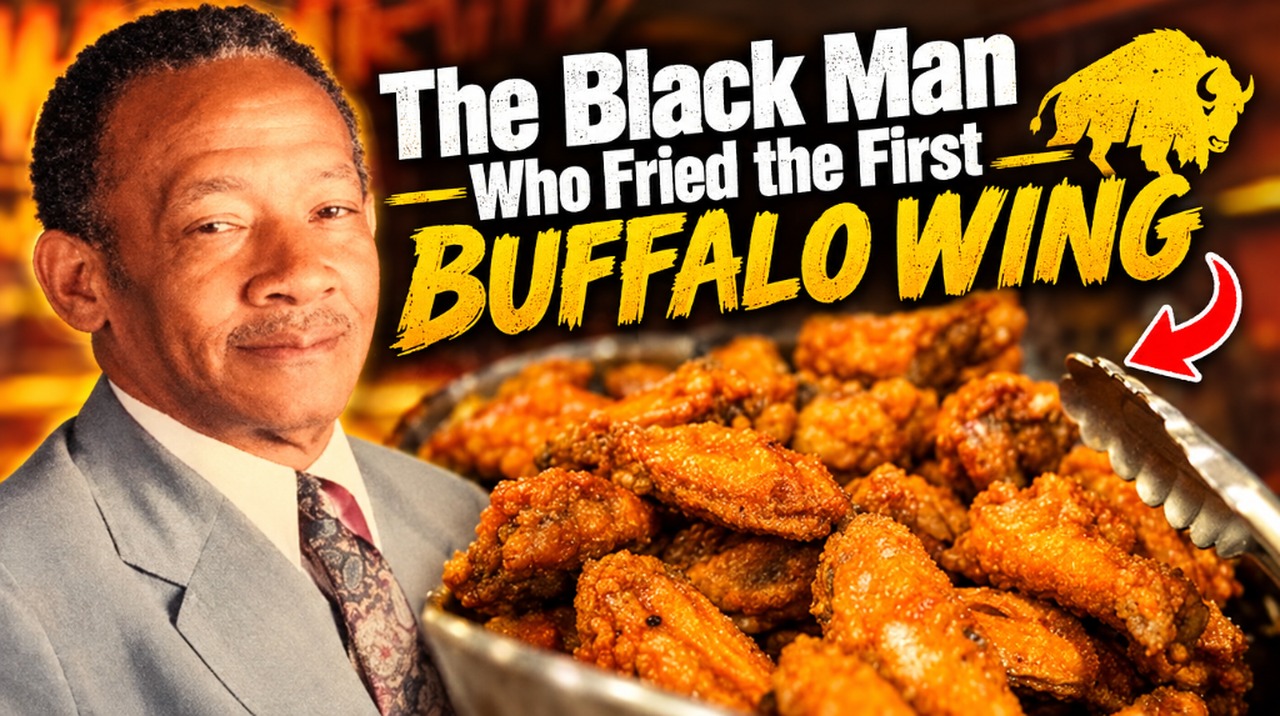
The Black Man Who Fried the First Buffalo Wing, and the 60-Year Fight to Get His Name Back
Every Super Bowl Sunday, a hundred million people eat a dish that history handed to the wrong family. The story most of us grew up on is tidy. It is 1964, it is the Anchor Bar on Main Street in Buffalo, and it is Tere...
Advertisement

Every Super Bowl Sunday, a hundred million people eat a dish that history handed to the wrong family. The story most of us grew up on is tidy. It is 1964, it is the Anchor Bar on Main Street in Buffalo, and it is Teressa Bellissimo, a white bar owner, staring down a delivery of chicken wings meant for stock and deciding to fry them up for her son and his friends. That version has been printed thousands of times, told on television, and stamped onto menus from coast to coast. It is also, at best, half the story.
A Black restaurateur named John Young was selling chicken wings in Buffalo before the Anchor Bar's version became famous, and he was not selling them as an accident. He was selling them as his whole business. His restaurant was called Wings and Things, and he opened it on Buffalo's East Side, eventually landing at Jefferson Avenue and Utica Street on a stretch that was known as the city's Black Main Street. The wings he served were whole, not split, breaded and deep fried, then tossed in a tomato-based sauce he called mumbo, a name with roots in Chicago and a lineage that runs to this day through the Black-owned carryouts of Washington, D.C.
The record is messy in the way real history usually is. Young applied for a business license for Wings and Things in 1966, which is the piece of paper the official version leans on. But interviews with Young and with people who ate at his counter put him selling food under that name years earlier, with several accounts pointing to the early 1960s and Young himself claiming 1962. He told the Courier-Express in 1981, plainly, "I was selling 5,000 pounds of chicken wings in 1962." In that same interview he added the detail that matters most: "Mr. Bellissimo used to come into my place and eat my chicken wings."
That sentence is the whole argument. Young believed Frank Bellissimo got the idea from him, a mile or so up the road, and that the most famous bar food in America started behind his counter.
What the Bellissimos did was real and it was different. Their wings were fried and broken into pieces and tossed in hot sauce, and that is the version the country fell in love with, the version that became shorthand for an entire style of eating. When early press came looking for the origin of the dish, it went to the couple with the bar, the story, and the access. A 1972 feature in the Buffalo Evening News put them in print. An Associated Press story followed, then a cooking show appearance, and in 1980 a Calvin Trillin piece in The New Yorker that made Buffalo wings a national curiosity. Trillin also interviewed John Young, who told him the Anchor Bar was not first. That part did not travel.
The larger point is not that one family stole another family's recipe. It is that the version with the better marketing became the history, and the Black businessman who built a restaurant around the wing, at a time when most American kitchens were treating wings as scraps or stock, was written out of it.
Timing worked against Young too. By the early 1970s he had left Buffalo for Illinois, telling his family he was afraid for their safety as racial tensions and unrest spread through American cities. He came back about a decade later to a city where "Buffalo wings" were suddenly everywhere, attached to another restaurant's name. He spent the rest of his life arguing the record. He did get some recognition, including a citation from the Buffalo Common Council as the first to do it, but the history books did not move. John Young died in 1998, still not the answer most people give when the question comes up.
His family carried it. In 2020 his daughter, Lina Brown-Young, began cooking her father's recipe for Buffalo Bike Tours' historical wing ride, which honors him as the King of Wings. She has since sold Mumbo Wings 'n Things out of the Broadway Market in Buffalo, working alongside Waymon Brown, who worked with her father, serving the family sauce to people who had never heard the name. Last year a mural went up at her father's original location. "He was really a pioneer," Brown told Spectrum News. "He wanted to be recognized for this idea of utilizing the wing when most people were throwing it out." Lina put the ask simply: recognize it, accept it, and that would be great.
Historians have added the context that neither restaurant story includes. Cynthia Van Ness, director of library and archives at The Buffalo History Museum, found a Clarendon Hotel menu from July 1857 listing "Chicken Wings, fried," and an 1894 recipe in the Buffalo Commercial Advertiser. Wings were being cooked in Buffalo long before either restaurant. What John Young did was make them a destination, and Brian Hayden of the Buffalo History Museum credits him with opening the first Buffalo restaurant centered on the wing, which is a different achievement than inventing a sauce and just as important.
That is the honest shape of this story, and it is more useful than the myth. The chicken wing existed. The wing as a business, as a Black-owned specialty shop on Jefferson Avenue, with a sauce that carries a migration story from Chicago through D.C. into upstate New York, belongs to John Young. The hot sauce and the split wing that the rest of the country imitates belong to the Bellissimos. Both things are true, and only one of them got told for fifty years.
There is a reason this keeps happening, and it is not only about food. A Black entrepreneur builds something that works, the business is disrupted by forces outside his control, and the credit settles somewhere easier to repeat. Young did not lose the argument because his product was weak. He lost it because he left town in a decade when leaving was a safety decision, because he did not have a press agent, and because the story got written by people who never walked into his restaurant.
Advertisement
So the next time a plate of wings lands in front of you, the correct question is not who invented Buffalo wings. It is why the man who served them first had to spend his last years proving he did, and why his daughter is still out there every Wednesday doing it with a fryer and a family recipe instead of a plaque.
The answer is worth sitting with, and so is the wing.