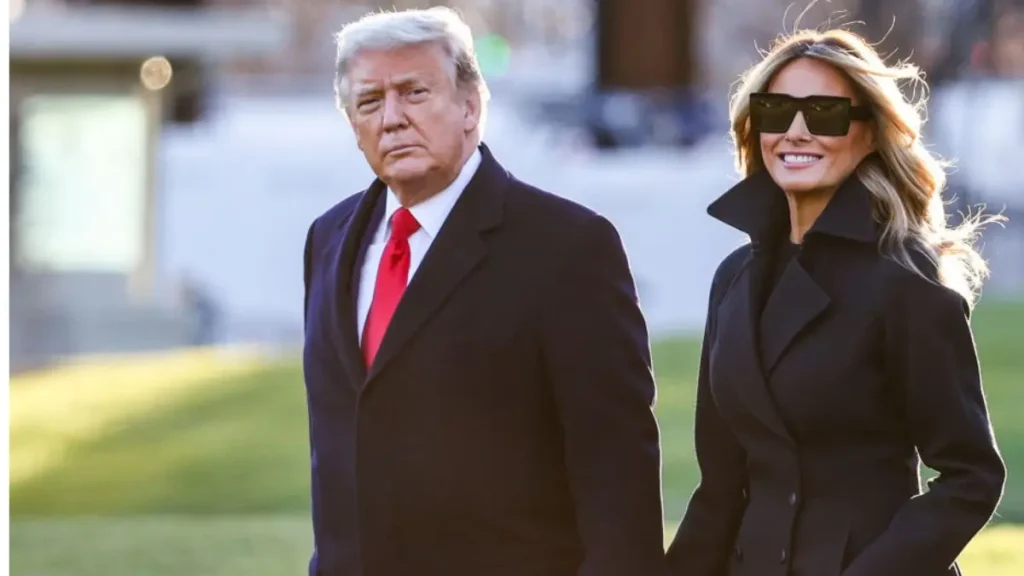
First lady Melania Trump shocked the political world when she stepped onto the national stage to address a growing scandal that has plagued her husband’s administration for years. The resurfacing of connections between Donald Trump and Jeffrey Epstein has sparked renewed scrutiny, prompting Melania to take a stand and attempt to divert attention away from the allegations. However, in her push to defend her husband, she has inadvertently pulled his ex-wives into the fray, igniting a debate about the historical pattern of women being sidelined in the fallout of political controversies.
Critics quickly pointed out that this isn’t the first time the Trumps’ personal lives have become fodder for public discourse. As Melania seeks to protect her family’s image, the narratives of Ivana and Marla Maples emerge once again, highlighting the often-neglected voices and experiences of women connected to powerful men. Whether it’s through whispers in the media or outright attacks from the political right and left, these women find themselves in a precarious position, where their past relationships are weaponized against them, often without their consent.
The irony is hard to ignore: while Melania strives to assert herself as the protective wife, her efforts only serve to reinforce the notion that women are frequently the collateral damage in the pursuit of male power. The dynamics of the Trump family saga echo a broader cultural theme where women, especially those tied to influential men, are thrust into the spotlight and must navigate a labyrinth of scrutiny and judgment. As they grapple with their own narratives, questions arise about agency, choice, and the societal expectations placed upon them.
In many ways, this new chapter in the Trump saga is reflective of a larger conversation about how society handles the personal lives of public figures, particularly when it involves women. As Melania continues to confront the Epstein allegations and the media glare aimed at her husband, it’s crucial to recognize the stories of Ivana and Marla, whose experiences remind us that behind every headline is a complex human story, often overshadowed by the pursuit of narratives that favor the powerful. In seeking to control the dialogue, Melania unwittingly opens the door to a dialogue about women’s agency and the resilience required to reclaim their narratives.
As this political drama continues to unfold, one can’t help but wonder: will Melania’s attempts to shield her husband truly be successful, or will the systemic patterns that have historically marginalized women rise to the occasion once more, forcing all parties involved to confront their pasts and the implications of their choices?
About The Author