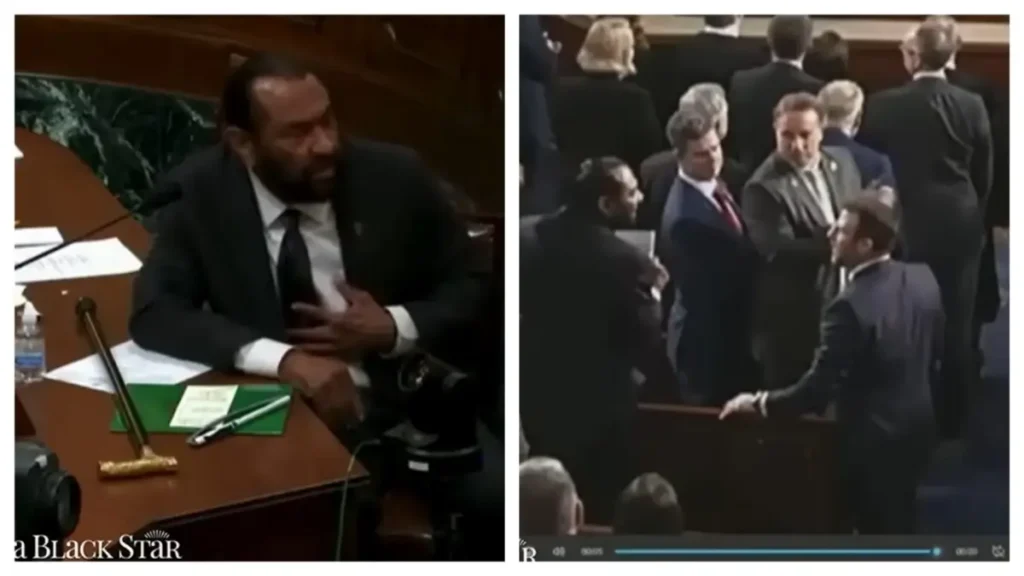
In a House hearing last week, Rep. Al Green turned his five minutes into one of the most charged moments of the congressional session. With the tension palpable, Green took on Rep. Mark Mullin in a way that was both pointed and strategic. Without uttering the word ‘racist,’ Green wielded his words like a scalpel, slicing through the thin veneer of civility that often cloaks such exchanges in Congress. It was a masterclass in political discourse, showcasing how to confront bigotry without resorting to overt accusations, a skill that many could learn from.
As Green confronted Mullin, the room was electric with anticipation. He addressed Mullin’s previous comments, which carried undertones that many in the room recognized but few were willing to name outright. In a moment that transcended mere politics, Green’s passionate plea for respect and dignity echoed through the chamber. It was clear: he was challenging not just Mullin, but the systemic issues that allow such rhetoric to persist in our society. When Green implored Mullin to ‘shut up,’ it was a culmination of pent-up frustration, a rallying cry against the cultural narratives that have long been accepted without question.
Then came the realization. Mullin, caught in the crossfire, began to grasp the implication of his actions. The weight of the moment settled over the assembly, and it was as if the entire room collectively held its breath. This was more than a simple congressional spat; it was a reflection of a society grappling with its own biases and the urgent need for accountability. The eruption of applause from the audience was not just for Green’s words but for the truth they represented. In that instant, the lines were drawn clearly: respect should never be optional.
What transpired in that hearing was a powerful reminder of the potential within our political system to address deep-seated issues. Green’s approach illuminated the art of speaking truth to power, encouraging others to find their voice in the face of injustice. This was not just a moment in Congress; it was a moment for the culture, a call to action that resonated beyond the chamber’s walls. As the dust settled, one thing remained clear: silence is no longer an option.
About The Author