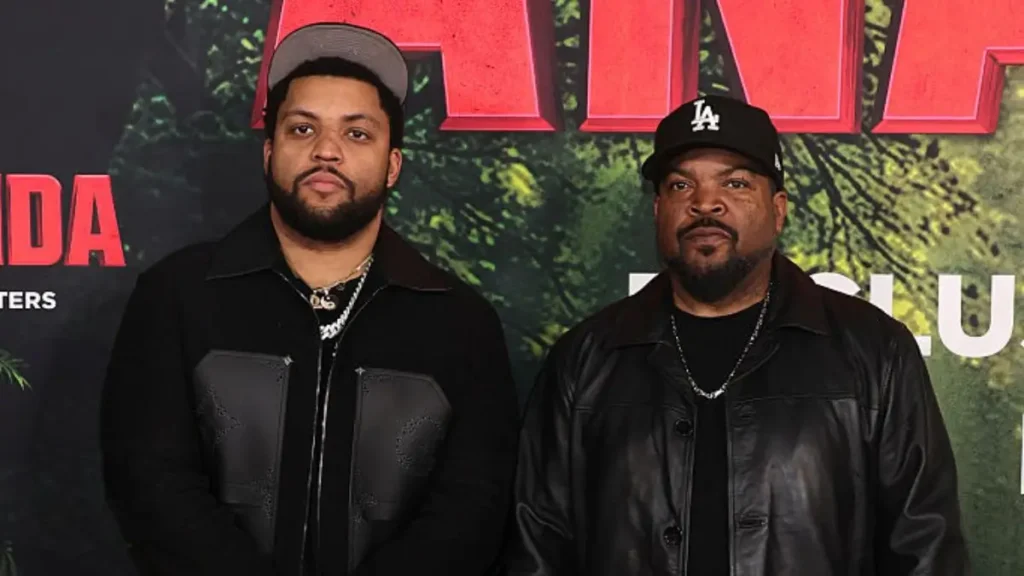
In the world of Hollywood, even the slightest offhand remark can ignite a firestorm of debate, and O’Shea Jackson Jr. just learned that lesson the hard way. The talented son of legendary rapper and actor Ice Cube made a playful joke recently that landed him in hot water, prompting critics to take aim not just at him, but at his father’s film career overall. It’s a classic case of familial privilege colliding with the scrutiny that comes with it, especially for a figure like Ice Cube, whose contributions to entertainment are both revered and critiqued.
When O’Shea joked about his father’s recent projects, it was meant to be lighthearted, a brotherly nudge towards a veteran in the game. However, the internet quickly seized upon his words, unleashing a torrent of commentary that was far from playful. Some detractors took this moment to question Ice Cube’s filmography, highlighting his more controversial titles while overshadowing his undeniable classics. This reaction speaks volumes about the pressures faced by offspring in the industry, where every joke can morph into a battleground, and every lighthearted comment can be interpreted through a lens of criticism.
It’s not the first time a child of a famous figure has faced backlash for their family’s legacy. The scrutiny intensifies when the parent is a cultural icon like Ice Cube, whose career spans decades of impactful work. While O’Shea Jackson Jr. is carving out his own niche in Hollywood, his father’s shadow looms large. Fans often find themselves torn between celebrating a legacy and evaluating new work without bias, which is a hard balance to strike.
This incident also raises larger questions about the expectations placed on family members of successful artists. In a world where every tweet, every joke, and every public appearance is caught on camera and dissected, how can the next generation of artists navigate the legacy left by their predecessors? For O’Shea, this moment is a reminder that the world is watching, and sometimes, even a joke can resonate in ways we least expect. As the dust settles, it will be interesting to see how both O’Shea and Ice Cube respond to this wave of critique and whether it sparks a broader conversation about the generational pressures in the entertainment industry.
In the end, perhaps this is just a reflection of our culture, where humor and legacy intertwine, and where the quest for authenticity continually collides with the societal expectations surrounding familial ties in the spotlight.
About The Author