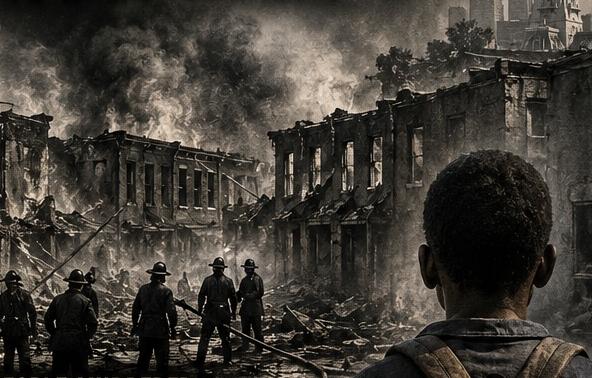
Forty-one years ago, West Philadelphia witnessed a tragedy that still reverberates through the community today. As a 9-year-old, I stood frozen in time as helicopters hovered above, their ominous blades slicing through the air like a knife through the fabric of peace. This was not just another day in my childhood; it was the day that the city transformed into a war zone, as the government unleashed a violent attack on the MOVE organization, a radical group advocating for Black liberation and environmental justice. The images remain etched in my mind, a haunting reminder of state-sponsored violence that left scars deeper than any physical destruction.
The MOVE bombing of 1985 marked a pivotal moment in the history of police brutality against Black communities in America. It was a prelude to the militarized tactics that have become all too familiar in contemporary society. Long before the Black Lives Matter movement took center stage, long before names like George Floyd and Breonna Taylor ignited a national outcry, we were witnessing the stark reality of a government at war with its own citizens. The very air was thick with smoke and sorrow as firefighters looked on, helpless to extinguish the flames that consumed a neighborhood. Eleven lives were lost that day, including five children, leaving behind a community grappling with trauma and grief.
Though decades have passed since that fateful day, the lessons learned from the M.O.V.E. bombing continue to resonate strongly in our discourse about race, justice, and accountability. The ghosts of those children linger in the hearts of their families and friends, serving as a stark reminder of the systemic failures that allowed such atrocities to occur. The echoes of their laughter, silenced too soon, compel us to confront the uncomfortable truth of our history and the ongoing struggles faced by marginalized communities. We cannot afford to forget; we owe it to the lost lives to ensure their stories are told and remembered.
Today, as we reflect on the legacy of the M.O.V.E. bombing, we must also recognize the intrinsic connection between past and present. The issues of police overreach, state violence, and community resilience have not dissipated; they have evolved. The fight for justice continues, fueled by the memory of those who came before us. In honoring their lives, we also ignite a fire within ourselves to advocate for change, to challenge the status quo, and to stand in solidarity with those still fighting for freedom. This is not just a history lesson; it is a call to action. As we move forward, let us remember that the spirit of brotherly love must extend beyond mere rhetoric. It must manifest in our commitment to justice for all.
From The Source
About The Author