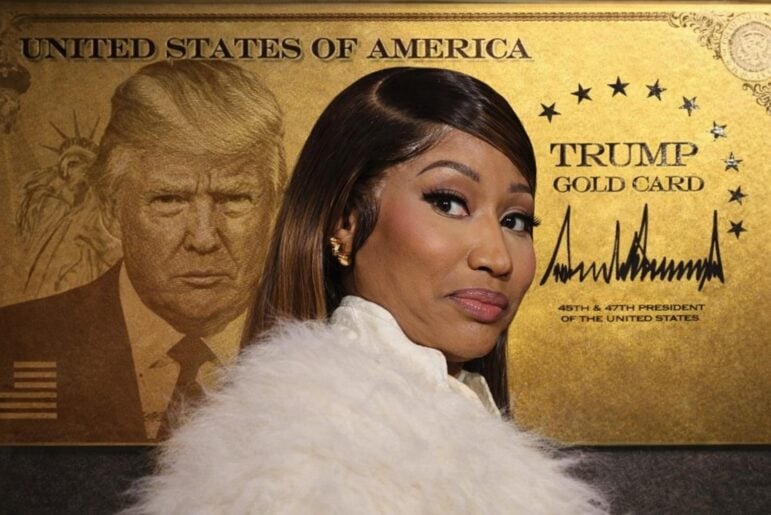
In news that has hip-hop Twitter arguing louder than a family reunion potato salad debate, Nicki Minaj has finally dropped the receipts on her shocking political realignment. In a new, 90-minute interview with TIME magazine (published May 14, 2026, conducted poolside at Mar-a-Lago, naturally), the Queen Barbie didn’t just say she likes Donald Trump. She went on to explicitly connect her shift to the perceived failures of Barack Obama and Jay-Z, claiming they set the stage for her embrace of Trump’s MAGA movement.
Minaj’s comments are reminiscent of a soap opera plot twist, leaving fans and critics scrambling to pick up the pieces of what many saw as a betrayal. According to her, the disillusionment began during Obama’s presidency, which she felt didn’t address the concerns of the Black community as aggressively as it should have. She also pointed fingers at Jay-Z, suggesting that his move towards corporate partnerships and the mainstream left behind many struggling artists, including herself. This combination of discontent appears to have fueled her pivot, leading her to embrace an ideology that many would have thought impossible for a figure like her in hip-hop.
The ramifications of Minaj’s statements are reverberating throughout the culture, sparking a frenzy within social media circles and leaving fans to grapple with the reality of a once-celebrated figure now aligning with a political faction that many in the Black community staunchly oppose. As she unapologetically defends her stance, it raises questions about authenticity and the cost of celebrity in a polarized political landscape. Is it possible that her desire for a more pronounced voice in political discourse led her to align with an agenda that starkly contrasts her previous views?
What makes this situation even more convoluted is the dichotomy within the hip-hop community itself, which has long been a microcosm of broader societal divisions. Minaj’s public shift not only highlights her personal evolution but also prompts a larger conversation about the role of celebrity in politics, especially when cultural icons begin to dictate their narratives in ways that challenge their foundational beliefs. As fans dissect her comments and responses pour in, the debate will likely continue to evolve, leaving us all wondering: what does this mean for hip-hop’s future engagement with political discourse?
In the end, Minaj’s claims against Obama and Jay-Z could be viewed as an attempt to rationalize her newfound political affiliations. However, as the dust settles, her ability to navigate the ever-changing tides of public opinion will be crucial to her legacy. Whether her support for Trump and the MAGA movement proves to be a temporary detour or a permanent pivot remains to be seen, but one thing is for sure – in the world of hip-hop and beyond, nothing is ever simply black or white; it’s all about shades of gray.
From The Source
About The Author