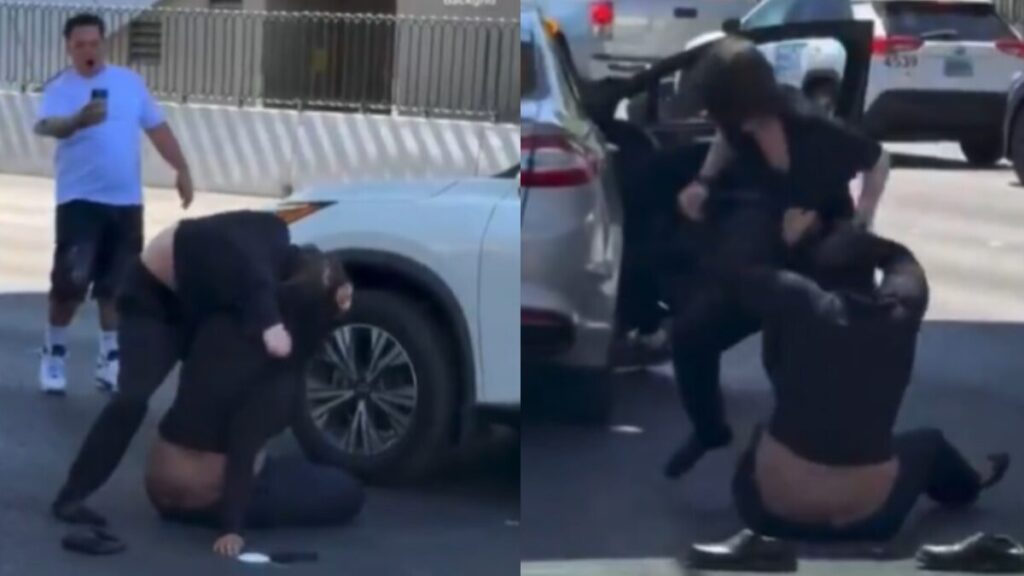
The internet is in an uproar following the release of a horrifying video showing a white man brutally assaulting a Black woman outside a Las Vegas event. This disturbing footage, which emerged from WrestleMania weekend, captures a moment where she is violently attacked, allegedly stemming from a road rage incident. What’s even more troubling than the act itself is the fact that bystanders stood idly by, lacking the courage or conviction to intervene. It raises unsettling questions about our collective societal responsibility, or lack thereof, in the face of injustice.
As we witness the footage circulating on social media, the outrage is palpable. Many are expressing their indignation, not just toward the assailant but also toward the onlookers who chose to record rather than intervene. In a world that often shies away from confrontation, this incident starkly highlights the cowardice that can permeate even the most public of spaces. The lack of action from those who witnessed this brutal incident underscores a troubling trend in our society: the inclination to capture violence rather than to act against it.
What should have been a moment to rally behind a victim instead became a spectacle for the masses, who watched this violence unfold through the lens of their smartphones. This behavior isn’t just morally reprehensible; it’s a reflection of systemic issues that allow such brutalities to persist without accountability. It serves as a reminder of the work still needed to change public attitudes about standing up for one another, especially for marginalized communities who already face disproportionate levels of violence.
In the aftermath, the conversation naturally shifts toward the importance of community and protection. When incidents like this happen, the silence from witnesses speaks volumes. It’s a clarion call for all of us to cultivate courage, to prioritize humanity over voyeurism. We must ask ourselves what kind of society we want to be a part of. Will we stand by as cowards, or will we rise as advocates for justice? The choice is ours, and it starts with unmasking our own complicity in the face of violence and injustice, actively choosing to stand up for the oppressed when it matters most.
About The Author