Congress Reclassified Us to Negro. Make Them Fix It
Virginia did not discover that the Monacan were Black. It decided they were, wrote it on a certificate, and made the lie the official record for a hundred years. Now Congress should be made to correct it out loud, in...
Advertisement

Virginia did not discover that the Monacan were Black. It decided they were, wrote it on a certificate, and made the lie the official record for a hundred years. Now Congress should be made to correct it out loud, in public, on the record, before this session ends.
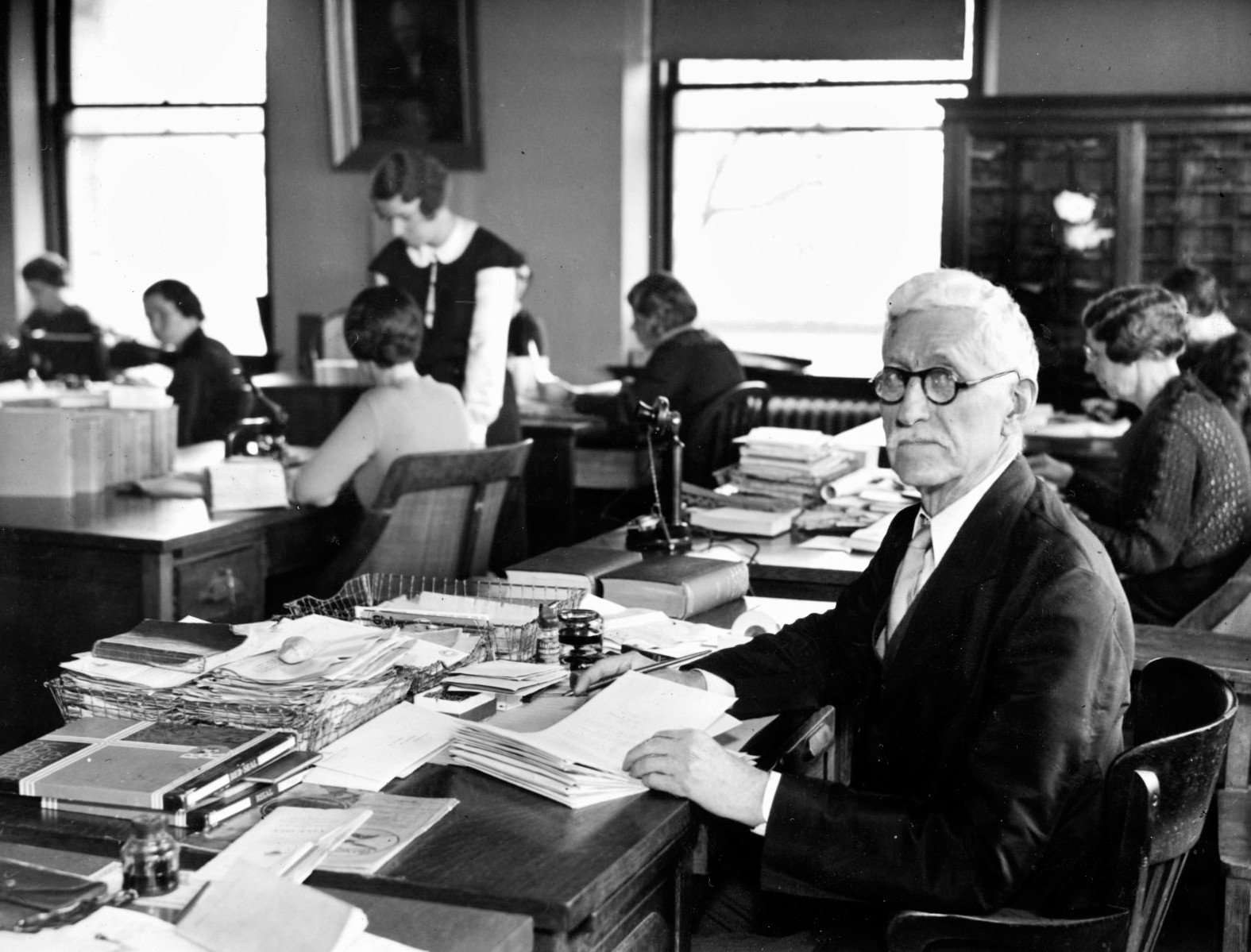
The man who did the deciding was Dr. Walter Ashby Plecker, a eugenicist who ran Virginia's Bureau of Vital Statistics from 1912 to 1946. He did not need violence to erase a nation. He needed a form, a filing cabinet, and the willingness of the state to treat his ink as biology.
A race built at a desk
On March 20, 1924, Virginia passed the Act to Preserve Racial Integrity. It defined a white person as anyone with "no trace whatever of any blood other than Caucasian," and it dumped every other human being in the Commonwealth into a single box marked colored. In 1930 the General Assembly sharpened the knife, defining a colored person as anyone carrying even one drop of what the statute called negro blood.
Read those two sentences together and the design is not subtle. Two categories, one of them superior, and a clerk with a pen deciding who goes where. This was not a description of the human beings in front of him. It was an assignment, made to guarantee that no matter how a family lived, worked, worshipped or buried its dead, the state could always point at the paperwork and say: not white, therefore beneath.
The Pocahontas exception gives the whole game away
The law's authors carved out one loophole. Families who claimed descent from Pocahontas and John Rolfe could stay white if their Native ancestry was one-sixteenth or less, because Virginia's gentry had spent generations bragging about that bloodline. Plecker hated the exception, not because it was racist but because it was leaky. He complained that "some of these mongrels" were registering as Indians and then "making a rush to register as white."
Then he wrote the sentence that became policy. "There are no native born Virginia Indians free from negro intermixture."
Take that in. One man's assertion, with no science behind it, converted entire communities into a legal fiction overnight, and the state of Virginia enforced it for decades. If no Virginia Indian was free of African ancestry, then Virginia had no Indians, and every Monacan, Nansemond, Chickahominy, Rappahannock, Mattaponi, Pamunkey and Nottoway family could be reclassified as colored on paper and treated as Black in law.
The letter that made it official
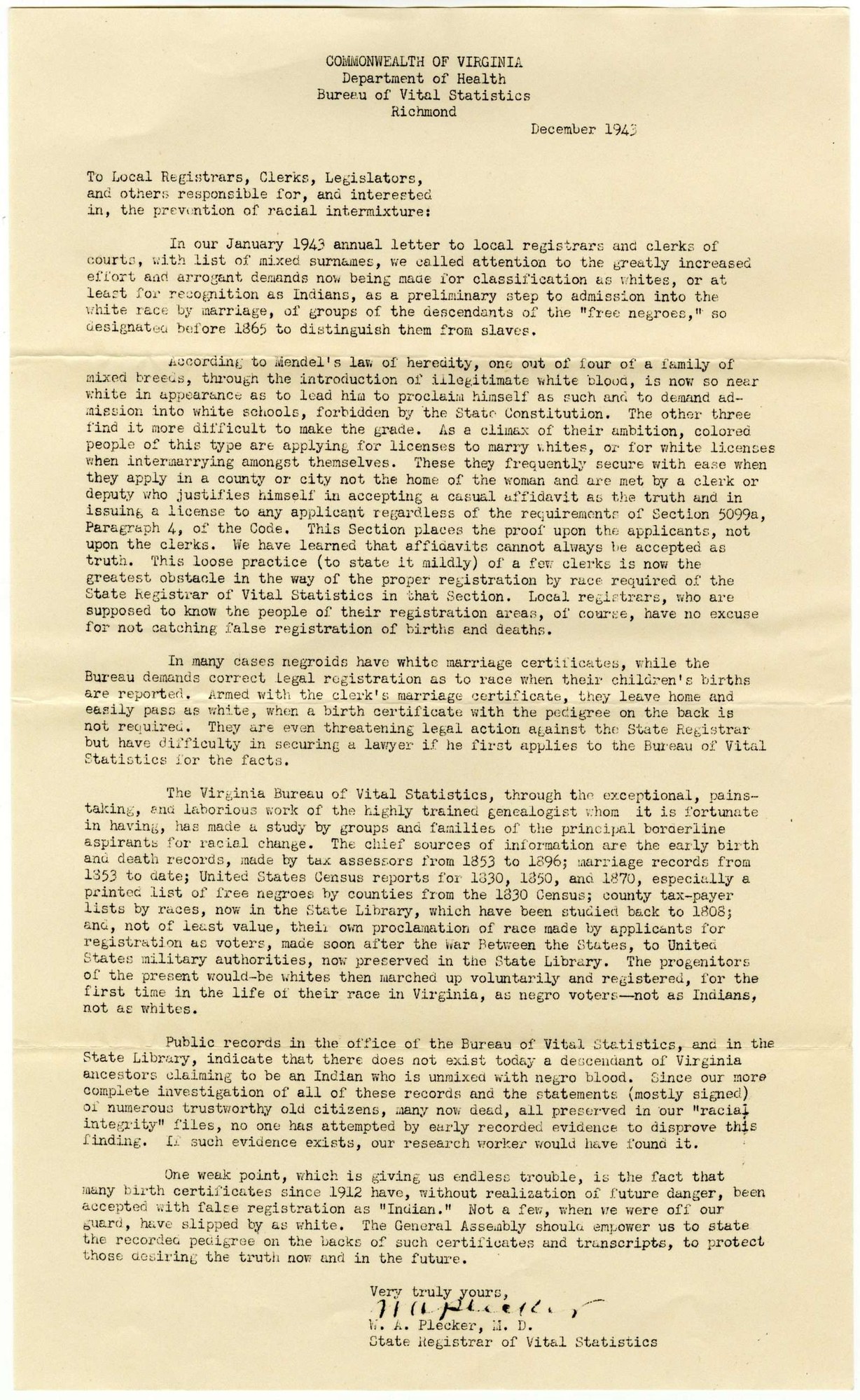
In December 1943, Plecker sent a circular to local registrars, physicians and clerks across Virginia. It did not argue. It instructed. It declared that the people in question carried "negro blood" and appended lists of surnames, sorted county by county, that his office had ruled belonged to "mixed negro-Indian families."
That is the mechanism, and it is why this story matters beyond Virginia. A registrar in a rural county did not have to know a single family to erase them. He had to recognize a last name on a list. Certificates that said Indian were overwritten as colored. Marriages were re-recorded. Children were pushed into segregated colored schools, and parents who objected to their own records were informed that the state knew better than they did about who they were.
This is paper genocide, the term the tribes themselves use, and no court has ever been asked to rule on it. The Racial Integrity Act survived until 1967, when the Supreme Court killed its marriage ban in Loving v. Virginia. The law died. The records did not.
What the word was built to do
Here is the part that gets waved off as a hot take in the comment sections. It is in the statute books.
Negro was not a description of a people. It was an administrative instrument, applied to anyone the state needed to hold beneath the line of whiteness, whether that person's ancestors came from West Africa, from a Monacan town on the Piedmont, or from a household where the two had been braided together for two hundred years. The category was designed by people who believed blood determined human worth, enforced by clerks with no medical training, defended by a state that criminalized arguing with them, and then absorbed into federal forms as though it were neutral data.
The federal government did not stop offering the word Negro as a race option until 2013. That is not ancient history. That is a box on a form that living Americans have checked, in a country that still asks every citizen to sort themselves into categories invented by eugenicists and then calls the answers demographics.
The bill nobody has paid
Virginia's tribes spent five decades proving who they were to a federal government that had already accepted the altered certificates as fact. The Chickahominy, Eastern Chickahominy, Upper Mattaponi, Rappahannock, Nansemond and Monacan finally won federal recognition in January 2018. The Pamunkey got theirs in 2015.
Chief Stephen Adkins of the Chickahominy described the cost: "We were the third rank in what was predominantly a two-race society." Sally Latimer of the Monacan Nation told PBS, "we're one of the only groups of people, race, that has to prove who we are." Chief Adams of the Upper Mattaponi called recognition "sort of a silly thing if you think about it, being recognized by the state for who you are," because no other people on this land has ever had to do that to exist.
Nobody has ever been held accountable for the paperwork. Plecker died in 1947 believing he had won, and on paper he did.
What we are demanding, and from whom
Congress can fix this without inventing a single new fact. The evidence is already digitized, already public, already sitting in the Library of Virginia in Plecker's own hand. What has never happened is a hearing where anyone from the federal government had to read it into the record.
We are demanding a public hearing on Plecker-era record alteration and its living descendants, convened jointly by the House Committee on Natural Resources and the Senate Committee on Indian Affairs, with the December 1943 circular and the county surname lists entered into the permanent record. No closed-door briefing. A hearing, with the letter on the screen.
We are demanding a concurrent resolution stating plainly that state and federal records were used to erase Native identity, that those alterations were administrative acts rather than findings of fact, and that the descendants of the reclassified are entitled to have the record repaired.
We are demanding that the National Archives, the Census Bureau and state vital records offices create a real correction pathway: an affidavit process backed by archival evidence, at no cost, with no deadline, that repairs a certificate a clerk altered and pushes the corrected record downstream to every agency that inherited the error.
We are demanding that the federal government stop coercing Americans into a binary built to rank them, restore ancestry and tribal affiliation as recordable facts, and let people correct a classification the government got wrong a century ago without hiring a lawyer.
And we are demanding an answer on the record from the members who represent the counties where those surname lists were enforced. They know the names. Their clerks kept the books.
How to make them answer
Call your representative and both senators. Ask for the hearing by name and ask whether they will co-sponsor a resolution on record alteration. Ask them to read the December 1943 letter before they respond to you. Tell them a state registrar wrote it so your neighbors could never prove who they were, and that the same government that kept those lists now claims it cannot find them.
Then send whatever answer you get to your tribal organization, because that is how a paper trail gets built to replace the one that was burned.
Advertisement
Plecker's lie is still the official record in more places than anyone wants to admit. It stays that way only as long as the people who know better stay quiet about it.
Watch the documentary now circulating as "Reclassified to Negro," then read the December 1943 circular yourself at the Library of Virginia. The record is public. Make them read it out loud.