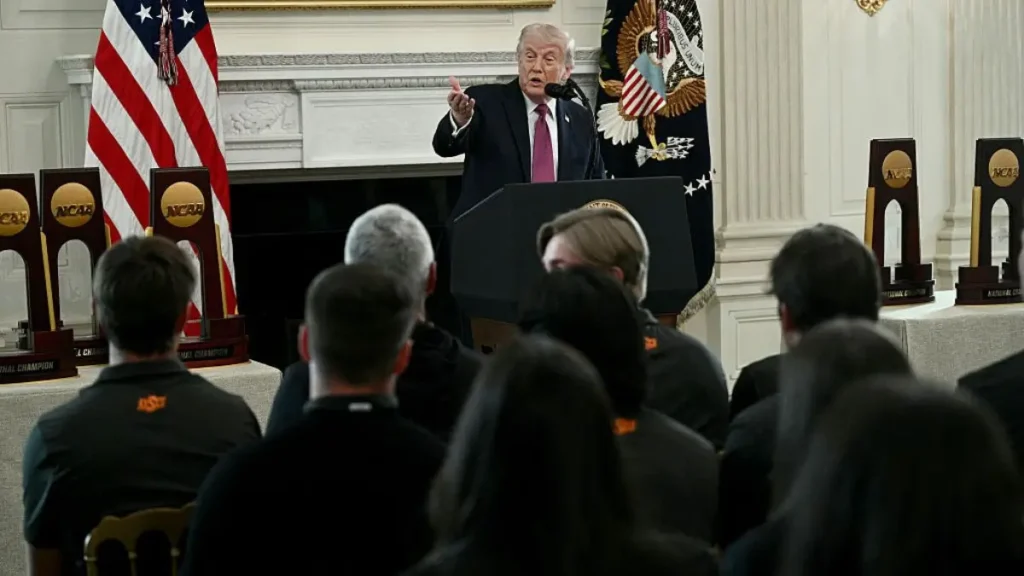
When President Donald Trump invited the latest golf champions to the White House, it was supposed to be a moment of celebration, honoring their athletic achievements. Yet, true to form, Trump managed to turn a simple gathering into another spectacle, rife with his trademark drama and theatrics. While the cameras flashed and the athletes posed with their trophies, a chilling detail hovered in the background, threatening to overshadow the occasion. As the world tuned in to watch the heartwarming camaraderie of champions, many were struck by the stark reality of the artwork gracing the walls—a portrait of Andrew Jackson, the seventh president of the United States, known for his controversial legacy and role in the Indian Removal Act of 1830.
This juxtaposition was not lost on many who watched. While the golfers basked in their glory, the presence of Jackson’s portrait served as a stark reminder of America’s complicated history, particularly in relation to race and power. Here were these athletes, who had worked tirelessly to achieve their dreams, standing in the shadow of a man whose actions had dire repercussions for countless people. It was an ironic twist that felt particularly poignant in a time when America is grappling with its legacy and the ongoing battle for equality.
Trump’s knack for making everything about him shone through once more. What should have been a moment for recognition quickly morphed into a stage for his political posturing. As the champions smiled for the cameras, the backdrop served as an unsettling metaphor, highlighting the often-overlooked narratives of oppression that accompany celebrations of success in America. It was a stark reminder that in every moment of triumph, there often lies a history that demands acknowledgment.
For those watching, it became clear that this gathering was less about honoring the champions and more about reaffirming Trump’s own narrative. The athletes deserved a moment free of historical baggage, yet the glaring reminder of past injustices loomed large, forcing viewers to confront uncomfortable truths. The surreal intersection of victory and historical weight was a fitting encapsulation of the complexities of American culture, where celebration and legacy often clash in unsettling ways.
About The Author