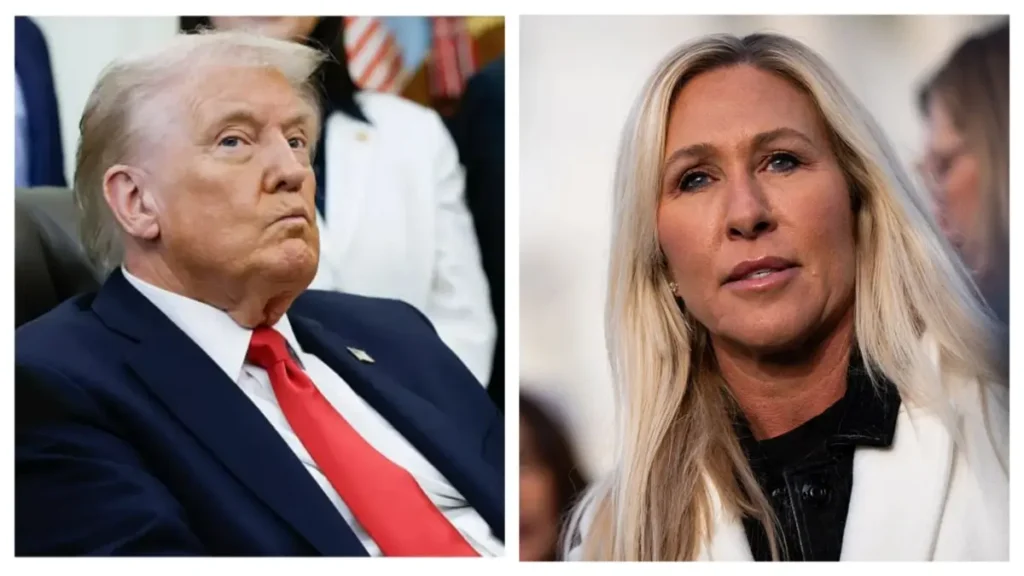
President Donald Trump’s approach to foreign policy, particularly regarding Iran, has become increasingly chaotic, leading even his staunchest allies to raise eyebrows. One notable figure, Rep. Marjorie Taylor Greene (MTG), recently made a shocking accusation that suggests there may be much more lurking beneath the surface of Trump’s decision-making. Her comments seemed to insinuate that the unpredictable nature of Trump’s war messaging might be a cover for something much darker and more sinister. Greene’s suggestion that Trump’s strategy could involve darker motives has sent ripples through political circles, leaving many to wonder about the implications of such a statement.
The tension surrounding Trump’s handling of international relations has never been more palpable, with critics questioning the direction of his administration’s policies. Greene’s claims, while provocative, add another layer to the already complicated layers of political maneuvering and intrigue. Historically, when political leaders engage in chaotic messaging, it often serves a dual purpose: to distract from domestic issues while simultaneously pushing a potentially dangerous agenda. Greene’s commentary, filled with implications of ulterior motives, draws attention to the fact that in the world of Trump politics, nothing is ever as straightforward as it seems.
As the geopolitical landscape grows more volatile, the public’s scrutiny intensifies. How much of Trump’s rhetoric is simply bravado, and how much is an indication of a more calculated strategy? Greene’s insinuation that there may be a willingness to “sprinkle in some murder” opens the door to questions about accountability and morality in leadership. It forces us to confront the uncomfortable truth that the stakes have never been higher, and the repercussions of careless governance can be catastrophic, both at home and abroad.
For many, Greene’s bombshell underscores a profound sense of distrust that permeates contemporary politics. It highlights the struggles we face in distinguishing between genuine leadership and the machinations of power-hungry individuals. As the political landscape shifts and evolves, it’s essential for us to remain vigilant, questioning the narratives that are presented to us by those in power. After all, in a world where chaos reigns, and messages are muddled, it’s up to us to stay informed and engaged, to seek the truth behind the rhetoric, and to demand accountability from our leaders.
About The Author