
Nicki Minaj Backs Blakeman: What Hochul’s Reply Misses
By Tanya Brooks, PowerVault Staff Nicki Minaj backed Bruce Blakeman against Kathy Hochul, turning the New York governor’s remarks about Black Bronx children into a political confrontation. Hochul answered by suggestin...
Advertisement

By Tanya Brooks, PowerVault Staff
Nicki Minaj backed Bruce Blakeman against Kathy Hochul, turning the New York governor’s remarks about Black Bronx children into a political confrontation. Hochul answered by suggesting Trump rallies were “poisoning” the rapper’s mind. That response gave the exchange another target without settling the original complaint. With the November 3 election approaching, Minaj specifically appealed to Black and Christian voters, putting identity and faith behind her endorsement. Black voters deserve better than choosing between an insulting description of their children and a celebrity endorsement presented as a moral command. The real stakes sit beyond who delivered the sharper comeback: what either candidate intends to deliver for the people being argued over.
The supplied reporting identifies Blakeman, the Nassau County executive, as the Republican challenger and describes Minaj urging Black and Christian voters to support him. It also places their exchange around a gubernatorial debate where Hochul accused Blakeman of associating with white supremacists. He denied that accusation and redirected attention to her Bronx comments. During their only gubernatorial debate, he called those remarks “reprehensible,” making them part of his own campaign argument. The originating news outlet is not identified in the provided material, so that allegation should remain clearly attributed to Hochul. Separately, Vaughn Golden’s post on X documents the governor’s response to Minaj. Those are distinct pieces of evidence, not interchangeable proof of every claim circulating around this fight.
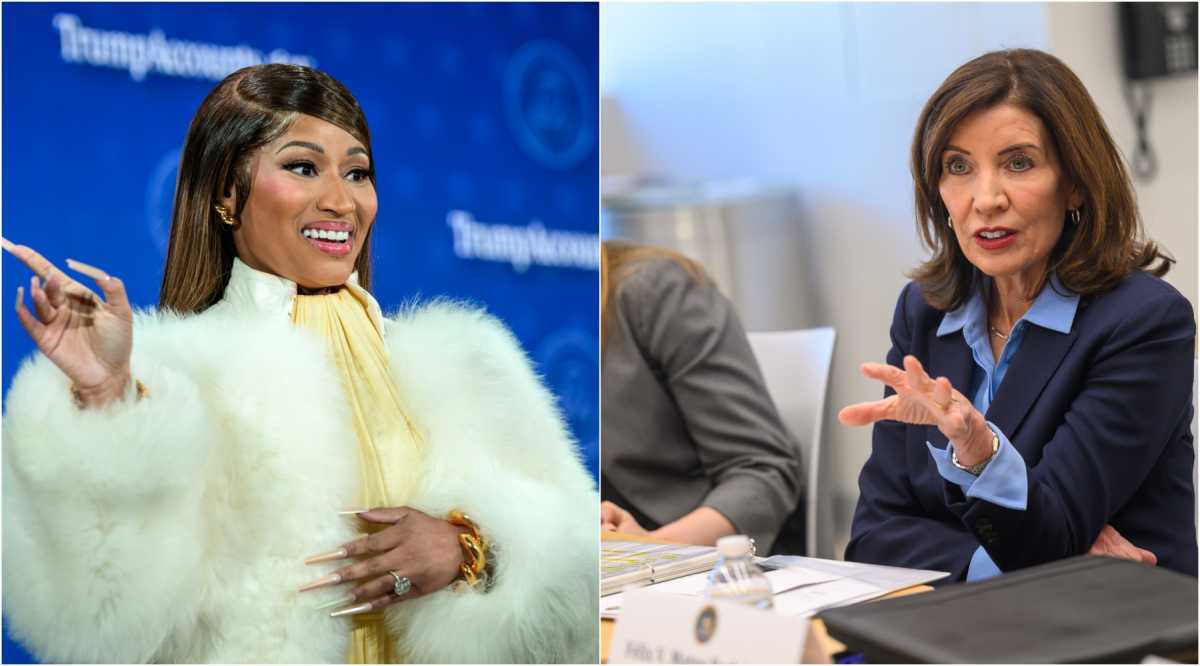
Hochul’s answer focused on Minaj’s political company and online habits. “Maybe she oughta get outside and get offline a little more,” she told reporters. The governor added, “And stop going to Trump rallies, it's kinda poisoning your mind.” That is a personal rebuttal, not an explanation of what she meant about Bronx children. The distinction matters because a public official can challenge an entertainer’s politics without leaving the underlying criticism unanswered. Minaj’s support for Trump does not make Hochul’s words disappear. Neither does a dismissive joke become a defense of those words. For Bronx families, the relevant question remains what assumptions their governor carries about their children and their capabilities. The clip below captures the governor choosing that line of attack.
The clip shows Hochul addressing the rapper rather than the substance of the Bronx remark. Her earlier statement was explicit: “Right now we have, you know, young black kids growing up in the Bronx who don’t even know what the word computer is.” She continued, “They don’t know, they don’t know these things. And I want the world opened up to all of them.” The stated goal was opportunity, but the wording confused unequal access with ignorance. A child can understand computers perfectly well and still lack reliable broadband, updated equipment or classroom support. Those are failures of access, not evidence that a borough’s children need someone to introduce them to modern life.
Minaj answered with condemnation rather than a narrow policy critique. “Kathy Hochul is an evil woman,” she wrote on X. She also argued that the Democratic Party should “forfeit her seat” and warned that Hochul would not escape “God’s wrath.” She predicted a “Downward spiral for her,” framing the governor’s political future as punishment rather than an electoral contest. Those are the rapper’s judgments, not established findings about the governor. They push the dispute into spiritual condemnation, where disagreement becomes a test of righteousness instead of a debate over governing. The wording also gives Hochul room to answer the temperature of the attack rather than its substance. Minaj’s post below shows exactly how far beyond the original remark her criticism traveled.
That post belongs to a longer history of rap celebrity meeting electoral power. Sean Combs helped popularize “Vote or Die!” during the 2004 presidential campaign, making voter participation part of music television’s daily conversation. Lil Wayne publicly praised Trump in October 2020 after meeting him about criminal justice reform and the proposed Platinum Plan. Minaj’s own position has shifted: the supplied reporting quotes her rejecting the “Donald Trump bandwagon” in 2020, then later calling herself his “No. 1 fan.” Her recent appearances alongside administration officials also put that support beyond a stray provocative post. These examples are not identical endorsements or identical politics. Mobilizing participation and recommending a particular candidate carry different responsibilities to the audience. They show why an artist’s political standing must be assessed through specific actions, not borrowed automatically from musical achievements, audience loyalty or cultural influence.
Nobody’s catalog is strong enough to make a voter surrender the right to ask for receipts.
An endorsement is not a publishing split: fans do not owe their favorite artist a percentage of their political judgment.
Minaj has every right to change her politics, and Black artists do not owe Democrats permanent allegiance. But a change in allegiance invites questions about standards, consistency and the policies behind the endorsement. Calling Hochul evil does not explain why Blakeman would govern better. Invoking Christianity does not establish which housing, education or health proposals deserve support. The rapper’s strongest argument concerns the governor’s actual words. Her weakest move is treating agreement with her preferred candidate as proof of moral seriousness. Blakeman still has to earn the votes she is requesting; inheriting anger at his opponent is not the same thing. An endorsement is not a publishing split: fans do not owe their favorite artist a percentage of their political judgment. Respect for her work can coexist with scrutiny of her choices.
Campaigns benefit when a celebrity delivers an argument directly to an audience they would otherwise have to reach through advertising or organizing. That does not establish a payment, contract or secret arrangement here; the supplied reporting provides no evidence of one. It does explain the value of the attention. Music fans understand how labels prize access to a committed fan base. Political operations prize that access too, even though an endorsement is not a record deal. A recognizable voice can get a candidate’s name into conversations where a campaign ad would get skipped. PVN’s coverage of Mamdani and Trump points toward the useful question: what does political proximity actually buy? Minaj’s next post makes her preferred transaction clear: turn that attention into votes for Blakeman.
The post below that appeal explicitly challenges Black people and Christians over supporting Hochul. Readers should reject the idea that either identity comes with a single approved ballot. Black churches have helped organize voters, defend civil rights and hold officials accountable. Their members still disagree about candidates and public policy. The same independence applies to a fan base. Streaming an album does not enroll somebody in an artist’s political organization. Minaj’s “HOW DARE YOU” framing puts supporters on trial before either candidate’s governing case gets examined. A useful response would demand Blakeman’s specific commitments and Hochul’s measurable record, then compare them. Outrage can identify an insult. It cannot, by itself, tell a renter which candidate offers a workable housing plan or tell a parent whose school policy will help.
The class insult inside the computer remark deserves its own hearing. Describing Black Bronx children through presumed technological ignorance casts them as deficient before examining what their schools and households receive. That framing lets institutions look generous for offering resources they should already provide. Knowing the technology and being able to afford dependable access are two different things. Yet defending those children also requires more than using them as the emotional centerpiece of an endorsement. Neither a governor nor a superstar should turn residents into supporting characters. The Bronx helped give hip hop its start in 1973; it does not need cultural validation from Albany or celebrity permission to demand investment. PVN’s look at what Atlanta gets back from celebrity visibility applies the same test: recognition should produce something residents can use.
Advertisement
The next meaningful development would be a concrete answer from either campaign, not another assessment of Minaj’s personality. Watch for commitments on school technology, affordable internet and neighborhood investment, along with explanations of how those promises would be funded. Minaj can press Blakeman for those commitments as forcefully as she attacks Hochul. The governor can address the insult without treating a critic’s Trump affiliation as an escape hatch. Readers should also separate an endorsement from evidence that an endorsement changes votes. Celebrity attention has value, but public office carries obligations. The children invoked in this fight deserve a budget line, not another comeback.
More from PowerVault Network:
