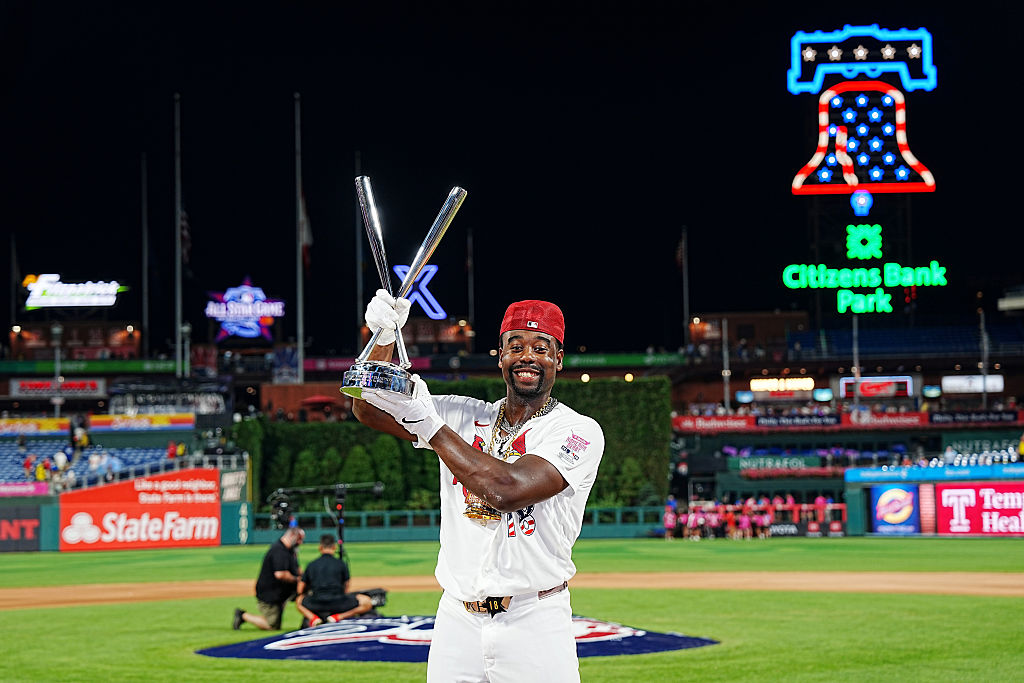
PHILADELPHIA, PA - JULY 13: Jordan Walker #18 of the St. Louis Cardinals poses with the trophy after winning the 2026 T-Mobile Home Run Derby at Citizens Bank Park on Monday, July 13, 2026 in Philadelphia, Pennsylvania. (Photo by Mary DeCicco/MLB Photos via Getty Images)
By Tanya Brooks, PowerVault Staff
Jordan Walker’s stunning performance at the Home Run Derby recently reminded us all of the powerful legacy of Black athletes in Major League Baseball. This young star not only walked away with the victory but also reignited a conversation around representation in the sport. His triumph echoes the accomplishments of iconic figures like Jackie Robinson, Hank Aaron, and Ken Griffey Jr., who have each paved the way for future generations. Walker’s achievement serves as a beacon of hope for aspiring Black players, showcasing that they can still find a home in a sport where their numbers have dwindled over the years.
To truly appreciate the significance of Walker’s win, we must consider the historical context. The percentage of Black players in MLB has seen a troubling decline since the 1980s, as the sport has become increasingly homogenized. The barriers that once stood tall are slowly shifting, yet the echoes of the past remain. With only about 7% of players in the league identifying as Black, it’s imperative to highlight victories like Walker’s, which bring visibility to a community that once thrived on the diamonds. His win is not just a personal triumph; it’s a rallying cry for the resurgence of Black talent in a sport that so desperately needs it.
From our perspective, Walker’s victory is an affirmation of the culture—the culture that birthed the flair, rhythm, and soul that has infused baseball with something truly special. It harkens back to the days when Black players transformed the game into a performance art, using their prowess not only to win but to entertain. As fans, we can’t overlook how pivotal representation is in sports. When young Black boys and girls see someone who looks like them dominating a stage as grand as the Home Run Derby, it sends a powerful message: you belong here. The emotional weight of that representation cannot be underestimated. It fuels dreams and ignites aspirations.
If we take a moment to reflect, Walker’s moment also draws comparisons to the groundbreaking days of the 1990s when players like Griffey Jr. and Barry Bonds were not only celebrated for their talent but also for their swagger—an unapologetic embrace of their identities. Just as Walker stands on the shoulders of giants, we can look back to those icons who made waves, challenging the status quo and bringing a renewed sense of pride to the game. Their presence in the league wasn’t merely about accolades; it was about reshaping the narrative and asserting the importance of cultural representation in baseball.
As we look to the future, all eyes should be on players like Jordan Walker and the impact they will have on the league and the community. The trajectory of Black athletes in baseball is still in motion, and victories like this serve as a springboard. It’s time for the MLB to invest in grassroots programs that nurture young talent from the inner cities, creating more opportunities for the next generation. Walker’s derby win reignites hope, suggesting that the tides might be turning once more. We must support these young athletes and push for structural changes within the sport. After all, representation matters—on the field, in the stands, and in the hearts of those who will carry the torch forward.
About The Author