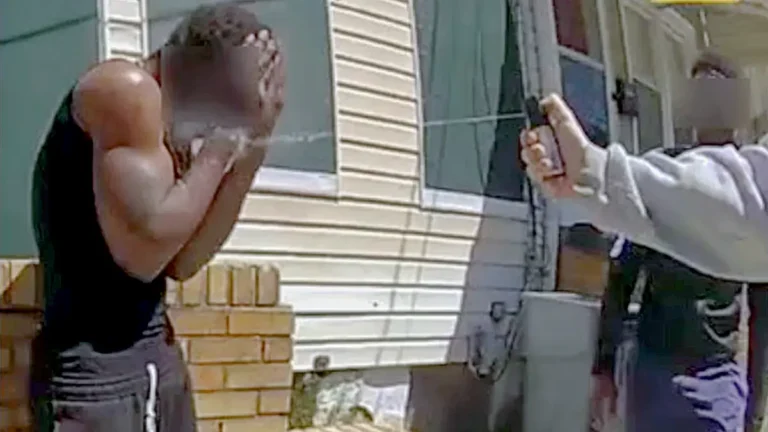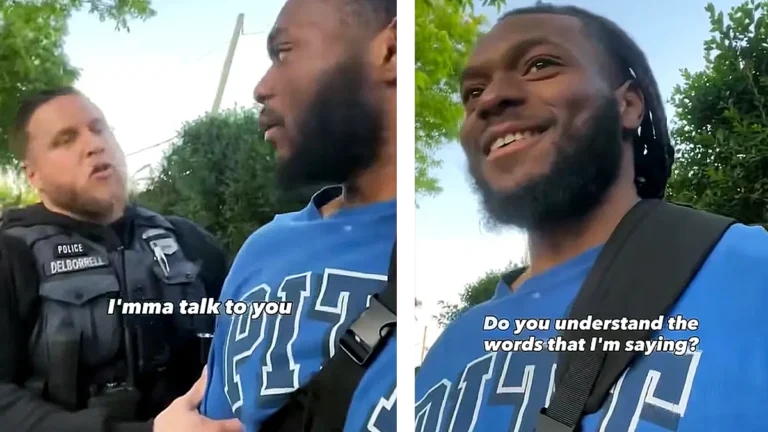
In a world where videos go viral at the speed of light, a recent clip of a Black police officer has sparked a heated debate online. The footage captures a tense moment during an arrest, where the officer, faced with a nearly exposed white female suspect, makes the conscious decision to avoid touching her. Dressed in a way that raises eyebrows during such a delicate situation, the woman’s attire becomes the focal point of the officer’s ethical stance. As he stands his ground, clearly asserting that he won’t compromise his integrity for societal expectations, the video leaves viewers split in their reactions.
Many are applauding the officer for his refusal to engage in what they perceive as a potentially compromising situation. They argue that his actions reflect a deeper understanding of the complexities surrounding race, gender, and the often fraught dynamics between police and citizens. In a society where the narratives of law enforcement can often tilt towards the problematic, this officer’s decision seems to serve as a refreshing departure from the norm. It’s a moment that raises questions about the power dynamics at play, especially when someone in a position of authority chooses to hold back, refusing to be drawn into a narrative that might be used against him.
However, not everyone shares this admiration. Critics argue that the officer’s refusal to assist could be interpreted as a lack of professionalism or, worse, a tacit acknowledgment of racial dynamics that unfairly burden Black individuals in similar situations. They suggest that his decision to stand back might be seen as a capitulation to stereotypes, reinforcing the notion that Black men cannot engage with white women without it being misconstrued. This line of thinking has ignited fierce discussions online, with people weighing in from all angles, questioning the implications of his choice.
The discourse surrounding the video highlights the ever-present tension in our society regarding race and authority. In moments like these, every action becomes a statement, and every decision carries the weight of historical context. While the internet may be divided over the officer’s decision, what remains clear is that the conversation is more important than the viral moment itself. These discussions challenge us to confront our biases and the societal constructs that influence how we perceive authority, race, and gender—a conversation that is long overdue in our culture.
From The Source
About The Author