By Renee Fontaine, PowerVault Staff
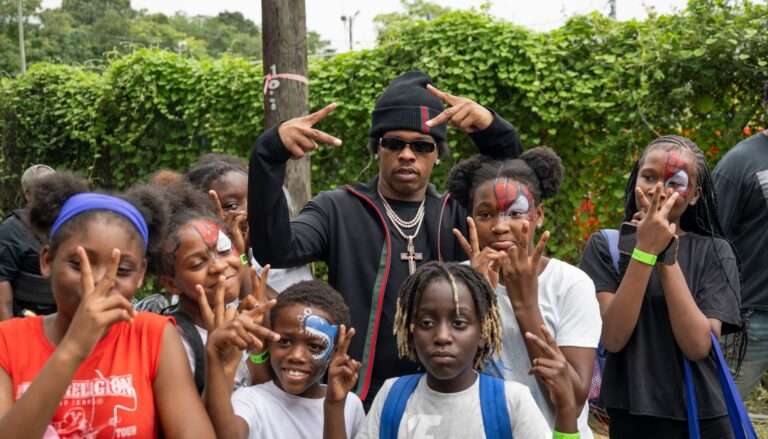
The first time a teacher lets the beat drop in class and the lesson actually goes harder than the original song, a kid’s whole face changes. That look, that mix of surprise and respect, is the moment a wall falls between “school” and “real life.” That is the space Brandon “Griot B” Brown walked into a decade ago and decided to build a whole new world around.
According to School Yard Rap, that wild gamble has now touched over 1 million students across 228 school districts. A million kids getting Black history, literacy and leadership through bars, not boring worksheets. That number is big, but the story behind it is bigger, because this is not just about one educator with a mic. It is about who gets to control the narrative of Black history, who gets paid off our culture, and whether hip-hop in schools will be a shortcut gimmick or a real tool for liberation.
Brandon Brown was not some outsider trying to “reach the youth” with corny raps. He was already in the system, a classroom educator who knew exactly how kids tuned out when the same dry textbook paragraphs showed up every year for Black History Month. Instead of just complaining in the teacher’s lounge about how the curriculum skipped from slavery to MLK to Obama like we did not do anything in between, he emptied his retirement savings and bet his future on a different vision: beats plus bars plus real history.
Think about how wild that is. Most people treat retirement accounts like sacred money. He treated his like seed funding. That move says something about where hip-hop is right now. Hip-hop is not just a music genre sitting on Spotify playlists. It is a language, a pedagogy, a way of organizing information and emotion. Brown basically said, “If schools will not update their system, I will build one that speaks fluent hip-hop and fluent Black history at the same time.”
Hip-hop education is not new in theory. Since the 90s, teachers have been sneaking Nas lyrics into English class and using “Dear Mama” to talk about poetry and metaphor. But what Brown did with School Yard Rap is package it, scale it, and walk it right into school districts as a full curriculum. Not a cute one-day assembly. Not a random “culture day.” Actual lesson plans, standards, and content where the hook carries more facts than a chapter summary.
Picture a 7th grade class in a majority Black district. Instead of another shallow Rosa Parks slide, the students get a track about Ella Baker, Fannie Lou Hamer and SNCC, with each verse breaking down strategy, organizing and risk. The hook is catchy enough to chant in the hallway, but the lyrics are giving receipts. That type of learning sticks. The same way a kid can remember every bar from a Lil Baby verse they heard twice, they can remember dates, names and freedom movements if the delivery respects their ear.
What makes this moment hit even harder is what is happening outside those classrooms. Across the country, school boards and politicians are trying to wipe out honest conversations about racism, slavery, mass incarceration and resistance. Entire states are banning books, watering down AP African American Studies, and pushing this idea that teaching real history is somehow “divisive.” We have seen this movie before. When people in power start controlling which stories get told, Black history is always the first on the chopping block.
So a program that centers Black history and civic engagement through hip-hop is not just cute; it is lowkey radical. It mirrors the energy behind things like Black August, where people are intentionally studying freedom fighters, political prisoners and resistance movements. School Yard Rap is basically Black August for middle schoolers, set to 808s and hi-hats.
There is also a power question here that looks a lot like the fights happening in politics and media. When you see arguments over what can be taught in schools, or why certain monuments and buildings matter, you are seeing a battle over memory and image. The same way we broke down why Trump threatening spaces like the Kennedy Center is really about cultural control in this piece on his Kennedy Center obsession, the fight over hip-hop in schools is about who gets to frame Black culture: us or them.
Traditional education systems have no problem mining Black creativity when it is safe and sanitized. They will rock with a “clean” rap about the water cycle. But once the bars start bringing up redlining, COINTELPRO, police violence and housing discrimination, suddenly it is too “political.” Brown’s work lives right on that line. When kids learn through School Yard Rap, they are not only memorizing names and dates, they are learning how systems work and how people resisted them. That is civic engagement, not just schoolwork.
There is also the question of authenticity. Hip-hop has always had tension with institutions. This is the culture that grew up outside the system, in parks, block parties, bedrooms and basements. Anytime it walks into big structures like corporate brands, universities, or school districts, there is a risk it gets watered down. Think about how the 2016 XXL Freshman Class felt like a real snapshot of a moment in rap, and then the way “Freshman lists” got more corporate and less risky over time. We broke that down in detail in our look at the 2016 XXL class. The same thing can happen with hip-hop education if people are not careful.
So the key question becomes: who is driving the bus? With School Yard Rap, the bus is clearly being driven by a Black educator who knows the culture from the inside, not a district trying to chase a trend. That matters. It is the difference between a teacher awkwardly dabbing to get students’ attention and a whole curriculum that treats hip-hop as a serious art form and a serious organizing tool.
There is also a generational thing happening here. Millennials and Gen Z grew up with hip-hop as the default soundtrack. The music was not an “alternative” or “urban” option; it was just how life sounded. Now that generation is old enough to be teachers, principals, school board members and parents. When they look at kids zoning out during a lecture, they are not just thinking, “These kids are lazy.” They are thinking, “This format is outdated.” Hip-hop in classrooms is part of a larger shift where younger Black educators are refusing to separate who they are from how they teach.
Still, there are real concerns that come with that million-student milestone. Success brings attention, and attention brings copycats. Corporations will absolutely try to spin up their own “hip-hop learning” apps with no community roots, no connection to real history, just algorithm-friendly beats and generic “you can do it” lyrics. Districts might decide to chase a cheaper imitation instead of paying for work crafted by people who actually understand the stakes. That is how culture gets stolen in slow motion.
It also raises the question of responsibility. Once you reach a million kids, you are not just a cool idea. You are an institution in your own right. That means pressure to keep the content sharp, historically accurate, and politically honest, even as more conservative districts might push back. It means handling criticism from within the community too, because not everybody will agree on which stories to tell or how far to go with topics like abolition, queer Black history or Palestine solidarity in a classroom setting.
What makes this moment feel different from past “hip-hop in schools” waves is the context our kids are living in. They are scrolling through videos of police violence, climate disasters, and political chaos before they even hit homeroom. Their attention spans are short, but their exposure is massive. We just watched how sports, politics and culture collided around Angel Reese and Caitlin Clark, with one missed layup turning into a full-on culture war that we broke down right here. Kids are not dumb; they feel those tensions even if adults pretend school is a neutral bubble.
Hip-hop is one of the few languages that can hold all of that at once: the pain, the politics, the joy, the flex, the history and the future. So when you give a 12-year-old a verse about Fred Hampton or Ida B. Wells and wrap it in a beat that sounds like what they were just listening to on the bus, you are not just teaching; you are connecting their present to a long line of struggle and genius. You are telling them, “You are not the first one to feel this. Here is how people before you fought back and built something.”
There will always be people who roll their eyes at hip-hop in schools, who think it is a gimmick or disrespectful to “serious” learning. Those same people probably thought hip-hop would die out in the 80s. Instead, it became the most influential culture on the planet, touching everything from fashion to film to how politicians talk when they try to sound “relatable.” Now it is sitting front row in the classroom, not just as a topic to be studied, but as the medium of the lesson itself.
The bigger question now is what comes next. A million students is a milestone, but it is not the finish line. Will more Black educators build their own curricula that use drill, Afrobeats, R&B and other sounds to teach science, math and financial literacy with the same energy Brown brought to history and leadership? Will districts that are terrified of “critical race theory” start quietly blocking this type of content, or will parents and students demand more of it? Will School Yard Rap and similar programs stay rooted in community, or will they get swallowed up by ed tech companies chasing the next “engagement hack”?
What is clear is this: hip-hop is not waiting for permission anymore. It is already inside the schools, in the headphones, in the group chats, in the way kids write, talk and think. Griot B just chose to meet it there with intention, with research, with risk, and with real love for Black history. A decade from now, when some of those 1 million students are running classrooms, campaigns, courtrooms or creative studios, do not be surprised if the way they tell their story sounds a little like a verse they memorized in 7th grade. The beat is already playing. The question is who will step up to keep teaching over it.
About The Author