By DeShawn Price, PowerVault Staff
The internet will watch a Black woman breathe and somehow turn it into a think piece about how she should be more grateful, more quiet, more forgiving, more anything than she already is. A soft launch of a relationship gets turned into a trial. A quiet breakup becomes a cross-examination. The court of public opinion loves putting Black women on the stand, then acting confused when they stop showing up to the hearing.
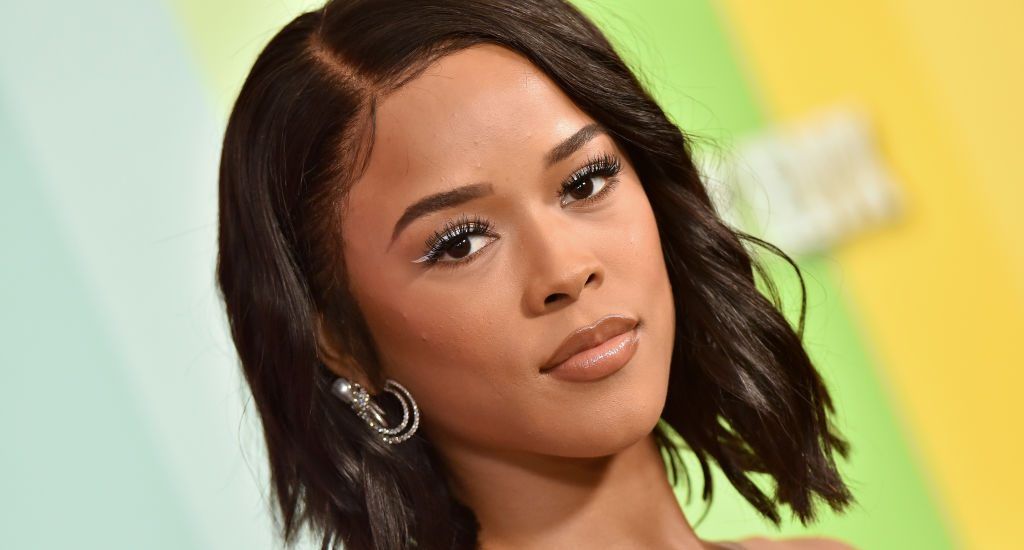
That is the energy hovering over the Serayah and Joey Bada$$ situation. Their breakup itself is not shocking. Celeb couples form and fade every day. What hits a nerve is how fast people pivoted from “they look cute” to “what did she do” and “she fumbled.” Serayah confirmed they are no longer together and barely had room to breathe before the comments kicked in. Somehow, a grown woman choosing to move on became a referendum on how Black women are allowed to date, leave, or simply change their minds.
Joey Bada$$ is respected in hip-hop as an artist with bars, taste and a certain cool factor. Serayah has been working for years, from Empire to music to brand deals, building her own lane. When they popped out together, the reaction was pretty much unanimous: this is a fly couple. Two beautiful, talented Black people, tapped into the culture, both with careers and ambition. On paper, it looked like the kind of pairing folks always swear Black women “should” go for. Then the relationship ends, and suddenly the same crowd that screams “Black love” is talking like she should be lucky anybody wanted her at all.
There is a pattern here that goes way beyond one couple. Black women are constantly told to choose “better,” to not settle, to stop holding down projects and start picking partners on their level. Yet when they do, and it does not work out, the blame still lands right back at their feet. The conversation rarely leaves space for the idea that a relationship can end without a villain. People cannot imagine that a Black woman might walk away simply because her peace mattered more.
Look at how different people talk when a man leaves versus when a woman does. When a famous rapper or athlete moves on, the narrative is usually about “growth,” “evolution,” or him not being ready to settle down. Fans will defend him with “you never know what was going on behind the scenes” and “he has to focus on himself.” When a Black woman leaves, the tone gets nasty quick. She is ungrateful. She is difficult. She is “for the streets.” She did not try hard enough. Even when there is no scandal, people create one so they can justify dragging her.
Social media has made this worse because folks treat real people like characters in a storyline they control. The same timelines that obsess over who is dating who are the ones that refuse to accept when those relationships do not fit their fantasy. That is how you get conspiracy threads every time a Black woman says, “We are not together anymore,” and nothing else. The silence bothers people because they feel entitled to her pain, her details, and her justification.
That entitlement is not new. It is just digital now. Back in the day, magazines and radio gossip did the same thing to women like Janet Jackson, Halle Berry, Nia Long. Every time a relationship ended, the quiet whisper was the same: “What is wrong with her?” Not, “Maybe she left because she has standards.” Not, “Maybe they both grew apart.” The script always read like Black women are the constant problem, no matter how different the men or the circumstances are.
That “what’s wrong with her” energy is the same logic that fuels the obsession with Black women’s bodies, choices, and even their medical lives. Look at how people reacted to the viral story of a woman with a so-called “cryptic pregnancy,” and how fast Black Twitter turned into a lab analyzing her choices and her body. That same energy was all over our breakdown of how a woman might not know she is pregnant. The common thread is control. People feel like Black women owe them full transparency at all times, or else they must be lying, confused, or irresponsible.
When Black women do open up, the response is not always kinder. Think about how Young M.A’s health and sobriety journey became public conversation. Even with her choosing to share parts of her story, there were still wild rumors and a lack of grace. That is partly why pieces like the look at Young M.A’s next chapter hit so hard. They show the cost of being vulnerable while Black and visible, and how even healing gets policed.
Romance is just another place where that policing shows up. Black women are expected to prioritize loyalty over their own sanity. Stay with him while he “figures it out.” Prove you are not “just like the others” by enduring more than anyone should. Fight for the relationship even when the relationship stopped fighting for you a long time ago. Then if you leave, you are the one who “gave up too soon.”
Hip-hop culture has always had a complicated relationship with Black women and respectability. On one side, rappers will praise “ride or die” women in their lyrics, the ones who hold the man down through jail bids, cheating, broke days and fame. On the other side, as soon as that same woman says she is done, she becomes a punchline. That mindset has followed us from the video vixen era, when women like Karrine Steffans were labeled everything but human, to modern day reality TV where women’s breakups are entertainment first and trauma second.
Think back to how people handled the Saweetie and Quavo breakup, or even Megan Thee Stallion’s fallout with Pardison Fontaine. The focus was rarely on, “Maybe she needed more.” It was “She fumbled” or “She must be difficult.” The culture is quick to crown a “relationship goals” couple, but even quicker to make the woman the villain when those goals do not last. That is not just messy fandom. It is patriarchy dressed up as stan culture.
There is also something specific about how people react when the man is seen as a “good guy.” Joey Bada$$ has a thoughtful, artistic image. He is not known for scandal or mess. That is cool for him, but the flip side is that fans project their own saint narrative onto him, which automatically paints any woman who leaves as ungrateful. People do the same thing in politics and sports, rushing to protect powerful men at all costs. It is the same instinct that showed up in reactions to Karen Attiah’s legal win, where folks questioned why a Black woman would ever challenge a major institution that others still romanticize.
This is not about dragging Joey or putting Serayah on some untouchable pedestal. Relationships end. Sometimes both people are cool, kind, talented, and still not right for each other. The point is how one breakup reveals just how tired so many Black women are of carrying expectations that nobody else has to shoulder. Expected to be endlessly loyal, endlessly forgiving, endlessly strong, and then endlessly silent about what it costs.
Fans love to say “protect Black women,” but protection is not just about jumping in front of hate comments or posting a hashtag when something horrific happens. It is also about the everyday language used when a Black woman chooses herself. Protection sounds like, “That is her business.” It sounds like, “She does not owe us an explanation.” It sounds like leaving room for her humanity, not turning her into a symbol of all your fears about love, loss and loneliness.
There is also a generational shift happening. Younger Black women especially are less interested in performing struggle love just to prove they deserve partnership. Therapy is more normalized. Conversations about boundaries and attachment and childhood trauma are mainstream. You can see it in everything from how people talk about Zuri Hall, Keke Palmer or Lori Harvey, to how women are approaching marriage, motherhood and timelines. That shift scares people who grew up believing that pain is just part of the package.
Meanwhile, the culture still rewards men for doing the bare minimum emotionally. A man goes to therapy once and suddenly he is “emotionally intelligent.” A woman leaves after years of carrying emotional labor and she is “cold.” This imbalance is not separate from how we talk about hip-hop, sports, or Black excellence. It all lives in the same ecosystem. The way fans react to a breakup is connected to what lyrics get celebrated, what storylines get greenlit, and which women get framed as “too much” whenever they step out of line.
Celebrity culture will not slow down, and neither will the internet’s need to have an opinion on everything. The real shift has to be in how we, as consumers of all this, decide to respond. Not every split needs a villain edit. Not every quiet exit needs a think piece about whether a woman “fumbled.” Sometimes the most radical thing the culture can do is let a Black woman tell us nothing and still respect her choice.
Watching how the Serayah and Joey conversation plays out in the next few weeks will say a lot about where we are. Will people keep digging for drama that might not be there, or will the story fade once there is nothing messy to chew on. Will media platforms lean into the double standard and feed it, or call it out and challenge it. The more Black women refuse to explain or apologize for choosing themselves, the more this old script about what they “owe” in love is going to crumble. That shift is not just about one actress and one rapper. It is about rewriting what Black love looks like when Black women are finally allowed to walk away without a trial.
About The Author