By Tanya Brooks, PowerVault Staff
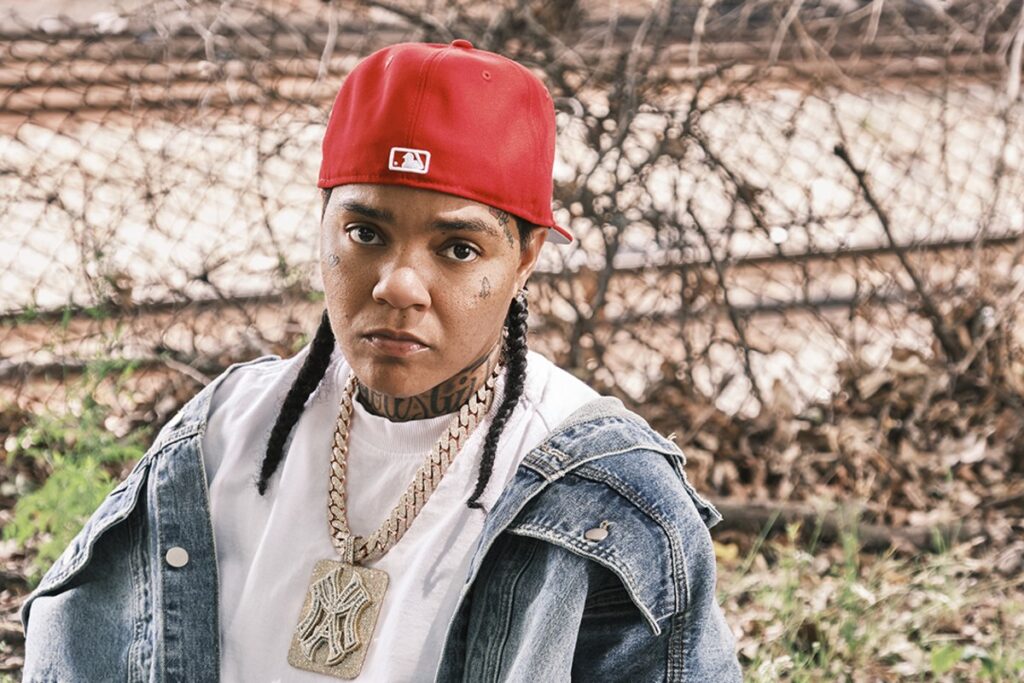
The first time Young M.A said “OOOUUU” on a beat, it felt like somebody cracked open a fire hydrant on a Brooklyn summer block. Raw, loud, uncontrollable, and everybody ran toward it. That record turned cookouts, college dorms and club nights into one big chorus. This was a young, openly gay Brooklyn rapper talking greasy over a New York beat, and it hit like the city had a new voice that did not care who felt uncomfortable.
Fast forward a few years and the conversation around Young M.A is not about who she dissed or what chain she got. It is about survival. Sobriety. Faith. Health scares that had fans whispering rumors and praying at the same time. The story now is not just “Is Young M.A sober?” but “What does it look like when a street-tough, hyper-masculine-presenting woman in hip-hop actually tries to heal in public?”
For a lot of fans, the turning point was that viral clip in 2023. Young M.A at the barbershop, eyes yellow, body clearly not where it used to be. Social media went from jokes to genuine concern in a matter of hours. There were wild theories, fake diagnoses, and people writing obituaries for someone who was still breathing. That is what fame does in 2024. Folks see one scary frame of you on a timeline and decide your whole life is over.
Young M.A pushed back, told people she had been dealing with health issues, said she was working with doctors and would update when the time was right. Later she opened up about being hospitalized, about alcohol and the way it had been a shadow in the background of her success, about needing to slow down before slowing down was not a choice. That honesty hit different because this was not some polished label statement. It sounded like somebody who had been to the edge and did not like the view.
Hip-hop has always had a complicated relationship with sobriety. Weed is celebrated, liquor is sponsorship, pills and lean are punchlines until they are funerals. When DMX cried out to God on records, when Gucci talked about quitting lean, when Mac Miller’s death shook the culture, those were moments that made the conversation feel urgent. Still, the default image of the rapper is someone turning up, not someone turning their life around.
Young M.A deciding to talk publicly about sobriety and faith cuts against that image. This is a woman who came in rapping about Henny, women, and spinning blocks. The music was gritty, the persona was “I am one of the bros, but better at rapping.” Hearing that same artist talk about putting the bottle down and leaning on God is a mental switch for fans who only knew the turn-up version of her.
For Black millennials and Gen Z, that switch is familiar. There is a whole generation of us who grew up on “pour up, drank” and are now in group chats talking about therapy, detoxing, and how many days we have been alcohol free. The same people who once quoted “I got a problem with drinking” as a caption are now sharing TikToks about the ways liquor is wrecking our sleep, our skin, our relationships. Young M.A stepping into sobriety is not a random pivot. It is part of a wider quiet rebellion against self-destruction that has been normalized in our music and marketing for decades.
There is also something important about who it is happening to. Black masc-presenting queer women do not often get this kind of arc in public. They get fetishized, mocked, or ignored. Young M.A was one of the few who broke through on her own terms, no “coming out” rollout, just bars and bravado. A health crisis forcing her to slow down and re-center on faith adds layers to that story that hip-hop has not always made room for. Vulnerability is usually reserved for the R&B girls or the “conscious” rappers. Seeing a Brooklyn stud rapper talk about God and sobriety challenges the narrow boxes we keep artists in.
Faith, in particular, is having a very visible moment in Black pop culture. From athletes praying on the court to artists thanking God onstage, spirituality is front-facing again, even when it is messy and personal. We have covered how power and image collide in politics with stories like why Trump is always flanked by Natalie Harp while Melania is missing from the frame. Image is never just image. For Young M.A, showing prayer, talking directly about God, and tying that to sobriety sends a clear message. This is not rebrand for clout. This is survival strategy.
Hip-hop has seen reinvention arcs before. Think about Gucci Mane walking out of prison visibly healthier with the ice cream cone still on his face but a completely different energy in his interviews. Think about when Wayne started speaking more openly about seizures and the toll of codeine. Or when artists like Kendrick and J. Cole began weaving therapy and inner work into their bars while the mainstream still pushed bottle-service fantasies. Young M.A’s next chapter feels like it is part of that lineage. Not a corny “after-school special” but a real-time evolution of somebody who has seen both sides of excess and is trying not to die behind it.
The industry is not built for people trying to slow down. Labels want touring, appearances, content, and more content. Fans want access. Blogs want drama. Add being a woman in a male-dominated genre and being queer on top of that, and the pressure multiplies. There is a reason so many artists crash out or disappear. Choosing sobriety in that environment is not a quiet personal choice. It is resistance.
There is also the reality that health conversations hit Black communities differently. When a Black man is found hanging from a tree and police are quick to call it suicide, like we reported in our coverage of the North Carolina case, it reminds everyone how fragile our lives are and how easily our pain is brushed aside. Black pain is either criminalized or sensationalized. Rarely treated with care. So seeing a Black woman rapper take control of her health narrative, speak on her own condition, and root it in faith rather than shame, quietly shifts that pattern.
What also stands out is how fans responded. Once the initial shock of those barbershop clips passed, there was genuine concern. People posted prayers, old freestyle clips, and concert footage talking about how much her music meant to them. The parasocial thing got real. It showed that under all the trolling and stan wars, there is a real desire to see our artists live. The culture is slowly understanding that losing icons back to back, from Nipsey to DMX to countless lesser-known names, leaves scars that do not fade. Nobody wants Young M.A to be another RIP graphic.
There is a gender layer here too. Male rappers get endless chances to crash and come back, often with their demons turned into branding. Women are rarely granted that same space. They are expected to be polished, perfect, unbothered. If they show cracks, the industry moves on to the next face. Watching Young M.A, who never leaned into traditional femininity, instead lean into honesty, is a reminder that Black women of all presentations deserve recovery arcs, not just cancellation or invisibility.
Faith and sobriety also change the music. When artists come out on the other side of something, their pen changes. Songs about nights in the club become songs about nights in the hospital. Flexing becomes reflecting. Fans will have to adjust to that. Some will miss the old M.A, the Henny-fueled punchlines and reckless energy. Others are ready to hear what she has to say now that the stakes are higher than a viral hit. The same way people connected deeply with personal storytelling in projects we broke down like “One Night Only” and its real-feeling soundtrack, there is room for Young M.A to tap into something more lived-in and reflective.
The truth is, the culture is aging. The kids who were screaming “OOOUUU” at house parties are now going to weddings in carefully curated fits from Black-owned brands, reading pieces like our guide to Black owned wedding guest looks, and talking about 401(k)s and blood pressure in the same breath. Artists who grew up with us are getting older too. Sober arcs, health scares, and faith journeys are not side stories. They are the main story of what happens when a generation raised on “live fast, die young” decides it actually wants to live long and see grandkids.
There is still a responsibility here. Media, fans, and industry folks need to give artists like Young M.A space to grow without turning their healing into spectacle. Sobriety is not linear. Faith wavers. Some days are relapse, some days are revelation. If every misstep becomes a trending topic, the pressure can push people right back into the same coping mechanisms they are trying to escape. Supporting this next chapter looks like streaming the music, respecting boundaries, and not demanding pain on demand for content.
What comes next for Young M.A will say a lot about where hip-hop is headed. If her new work is embraced, if a more grounded, sober, spiritually rooted version of her can still pack shows and move numbers, it signals that the culture is ready to value wellness as much as wildness. If not, we will have to admit we love to tweet “protect Black women” while still rewarding the exact structures that break them down.
For now, what matters is that Young M.A is still here. Still fighting for her body, her mind, her spirit. Still choosing to share pieces of that fight with people who have never met her but feel like they grew up with her voice in their headphones. Keep an eye on the next drops, the interviews, the subtle shifts in her lyrics and visuals. This chapter is not just about whether she can get another hit. It is about whether hip-hop will make real room for artists to heal without losing their spot. Young M.A’s journey into sobriety and faith is a test case, not just for her, but for all of us who say we love this culture and claim we want to see our people live long enough to enjoy the fruits of their work.
About The Author