By Malik Carter, PowerVault Staff
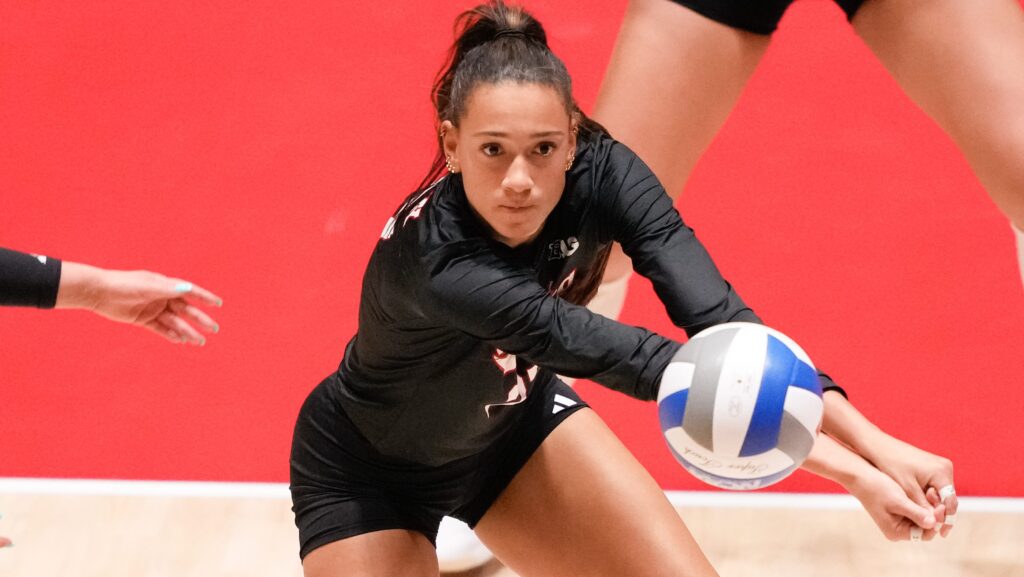
The sound hits first. That heavy echo of a kill bouncing off an arena wall, crowd screaming like it is Game 7, teammates sprinting into a huddle, hair flying, nails done, knee pads dusty. Then you realize the star in the middle of all that chaos is a Black woman, owning a sport that for decades barely made room for her.
For a long time, college volleyball at the highest level looked predictable. Packed gyms, powerhouse programs, championship banners, and almost all white faces on the court. Places like Nebraska built dynasties with that formula, stacking national titles in 1995, 2000, 2006, 2015 and 2017 while reflecting both their state and a sport that never really imagined Southside girls or AAU hoopers choosing a volleyball net over a rim.
That picture is different now, and not by accident. When Nebraska, Texas, Louisville, Pitt, and a wave of top programs hit the court this season, one thing jumps out through the TV screen. Black women are not just participating, they are starring, dictating who makes the Final Four, who wins player of the year, who gets talked about on ESPN, TikTok and in group chats. The sport that once treated us like a rare exception is starting to feel like another lane where Black talent is driving the conversation.
That shift is why lists like Andscape’s breakdown of the top Black Division I volleyball players matter. Not because fans need help understanding the game, but because visibility in a space that used to feel closed off is a form of power. When a little girl in Atlanta or Baltimore scrolls and sees a 6-foot-4 Black outside hitter snatching souls on national TV, that is the same energy kids got watching Serena at the US Open or Cheryl Miller at USC. It hits different when the highlight looks like your cousin.
Volleyball’s Black wave did not appear out of nowhere. Think about how many hoopers grew up being told basketball or track were the only real options if they wanted a scholarship. Meanwhile, volleyball clubs were expensive, far out in the suburbs, and culturally distant. Black parents had to drive 45 minutes to a warehouse full of nets where nobody looked like them, hoping their daughter did not feel like a visitor in her own sport. That kind of barrier kept entire generations off the court.
Now college coaches are hunting for Black talent the way AAU scouts stalk summer gyms. There is an understanding that if you bring that same bounce that shows up in a dunk contest to the volleyball court, you are getting above the block, changing angles, warping defenses. A 6-foot-2 Black outside with basketball legs is a cheat code. And when those women are given the right coaching, investment, and confidence, they break the sport open.
There is also a culture shift happening on campus. Look at Nebraska, a program that once dominated with mostly white rosters. Today, the Cornhuskers still own the sport, but the faces are more diverse, the swag is louder, and the energy feels closer to what fans see in college basketball or women’s soccer. When those players celebrate, there is rhythm, there is attitude, there is a quiet understanding that this space was not built with them in mind, but they are taking it anyway.
That is a familiar story. Volleyball is going through the same kind of transformation hip-hop went through in Hollywood. Studios loved our soundtracks but did not always want our full presence. That is why moments like Jamie Foxx pushing back on Quentin Tarantino over a scene in Django land so hard. It is not just about one movie, it is about a Black artist demanding control inside a system that thinks it knows best. The same dynamic shows up when Black volleyball players demand better facilities, real NIL deals, and real marketing instead of being treated like background pieces on their own teams. If that resonates, this piece on why Jamie Foxx fought Tarantino over a scene in Django Unchained hits the same theme in a different arena.
What makes this new volleyball era special is how layered the impact is. On the surface, it is about winning. Programs like Texas and Louisville are not adding Black talent as a feel good gesture. They are doing it because you are not winning national titles in 2026 without elite Black players on the pins and at middle. The speed, length, and power they bring have changed how the game is played. Sets are faster, offenses are more explosive, and blocks get punished if they are even a split second late.
Underneath the stats, though, this is about ownership of narrative. For years, the archetype of the “all-American volleyball star” was a certain look, a certain hair, a certain background. Now there are Black women with braids flowing down their back, tattoos showing under their sleeves, wearing jewelry in pregame and blasting Lil Baby in the locker room, and they are the face of the sport. That flips who gets to be considered the standard.
There is also a ripple effect around NIL and money. When a Black outside hitter at a top program starts building a brand with hundreds of thousands of followers, that is a pipeline for beauty deals, sportswear partnerships, and big stage commercials. Think about someone like Sha’Carri Richardson in track, who turned her look, attitude, and story into a conversation that went beyond her races. Volleyball is sitting right on the edge of that same kind of mainstream moment, and a lot of the players ready to cash in are Black.
That is why this matters for the culture. Every time Black excellence shows up in a new lane, it blows up another stereotype about where we belong. Sports are political, even when people pretend they are not. The same America that tries to control how Black people protest in the streets or vote at the polls also has opinions about where Black girls “fit” in sports. The more Black faces dominate in volleyball, golf, swimming, and gymnastics, the more those boundaries crumble. Just look at how wild certain people reacted to LeBron stepping into golf with his Akron PGA event. If you missed that, the piece on why LeBron James is launching a PGA Tour golf event in Akron shows the same energy of Black folks walking into a country club sport and refusing to shrink.
The timing of this volleyball shift lines up with a bigger wave in women’s sports. Angel Reese, Caitlin Clark, Flau’jae Johnson, and a whole generation of hoopers have turned women’s basketball into appointment TV. Track stars are going viral off one race. Gymnasts are pulling millions of views with a single floor routine. Volleyball is in that same conversation now. The NCAA’s record breaking attendance at volleyball matches is not a fluke. People are pulling up to see stars, and a growing number of those stars are Black.
There is also something powerful about how these players carry themselves. They are not trying to code switch for the cameras or shrink their personality to fit some old school idea of what a “team player” looks like. You see TikToks from team buses, lip gloss check before warmups, edges laid, playlists full of Future, Tems, Megan, and Burna, and then they walk into the gym and drop 20 kills on a rival like it is nothing. That balance of softness and power, glam and grit, is very Black, very millennial and Gen Z, and it is shaping how young girls think about being athletes.
Colleges and the NCAA know what is happening, even if they do not always say it out loud. Black women are making their sports more watchable, more marketable, more viral. That should come with real investment. Better pay for Black coaches. More Black head coaches, not just assistants. Stronger recruiting in Black neighborhoods, not just hoping those kids stumble into volleyball by accident. Community clinics, affordable club options, and real pipelines from city rec centers to Division I programs. That is how this moment turns from a trend into a permanent shift.
There is also a responsibility on media. Coverage can not just reduce these women to “athletic” or “explosive” without talking about IQ, leadership, and skill. That language has followed Black athletes forever. In football, quarterbacks were labeled “dual threat” as a backhanded way to avoid calling them smart. In basketball, Black point guards were “pure athletes” while white ones were “floor generals.” Volleyball has its own version of that. If this new wave of coverage is serious, it has to treat Black stars as complete players, not just highlight machines.
For the culture, this is another reminder that Black excellence does not need permission. These women are walking into a sport that never built itself around them and still taking up the center of the frame. That same energy shows up when artists, activists, and athletes refuse to let systems box them in. Whether it is a foodie like Keith Lee turning a simple review into a platform that can boost or expose whole businesses, like he did with Raising Cane’s as covered in our breakdown of his Raising Cane’s collab, or a college middle blocker from the South Side of Chicago turning a scholarship into a shot at the Olympics, the throughline is the same. Black choices, Black platforms, Black power.
Over the next few seasons, expect to see more young Black girls choosing volleyball first instead of as a backup sport. Expect to see more packed arenas where the loudest cheers are for Black stars at the net. Expect NIL deals that put volleyball athletes in the same campaigns as hoopers and track stars. And expect the old guard to either adjust or get left behind. This new wave of Black Division I volleyball players is not a side story. They are the plot. And as more of them rise, the sport, the money, and the culture around it will have no choice but to move with them.
About The Author