By Jasmine Reed, PowerVault Staff
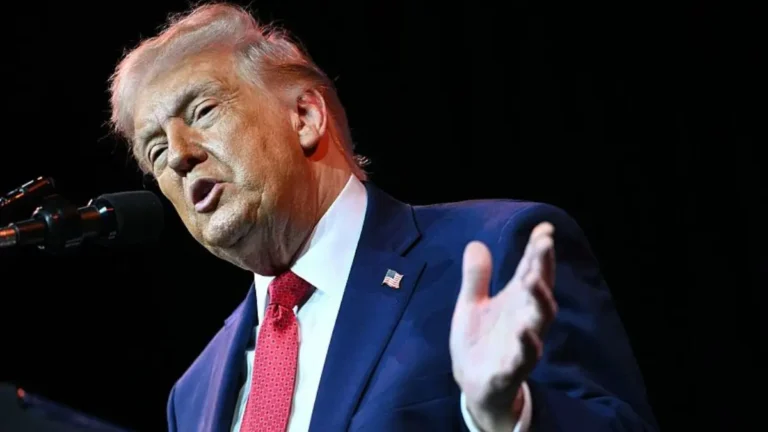
The camera never blinks. Rappers know it, athletes know it, every celebrity who ever tried to fake it for the ‘Gram knows it. Eventually that lens catches the truth, no filter, no PR spin, just you. That is exactly what happened when Donald Trump stepped off Air Force One, tried to play it cool, and the whole world watched his body tell a different story than his mouth has been selling.
This latest clip of Trump doing that slow, careful, almost lonely walk down the stairs from Air Force One lit up social media because it feels like a sequel. We have seen the ramp shuffle at West Point, the water-glass-with-two-hands moment, the random freeze ups at rallies. Now here he is again, moving like every step is a calculation, eyes fixed, trying not to look down while the cameras are zoomed all the way in. No Melania, no aide, no Secret Service arm in reach, just a man trying to convince you everything is fine while his whole body is saying something else.
People are not reacting to one awkward walk. Folks are reacting to the pattern and the timing. Trump is 80, running for the presidency again, facing serious criminal cases, and actively trying to control the narrative around his health. That is why he always pushes those “Biden is too old, too weak” lines so heavy. But when your own steps start looking like a blooper reel, the storyline flips. Suddenly the guy calling everybody else fragile is the one moving like the floor is lava.
There is a reason the jokes online got dark quick. Black Twitter immediately pulled out the “Don’t Look Up” jokes, the “stair boss fight” memes, comparing the Air Force One stairs to a Mario level. Because at some point, when leaders keep lying in your face, humor becomes a survival tool. Folks are tired of being gaslit about everything from racism to voting rights to police violence. Watching a powerful white politician pretend the audience cannot see what is literally right there on HD video hits a nerve.
Trump has always treated politics like reality TV. He knows how to stage an entrance, how to walk to a podium like it is a WWE ring, how to turn a rally into a concert he headlines. That is why these unflattering clips land so hard. When the brand is “strongest, healthiest, most energetic,” walking down a set of stairs like you are one misstep away from disaster turns into a storyline you cannot edit out. It feels like watching a rapper whose whole persona is invincible street legend suddenly get winded on stage mid-performance. We have seen how fans responded when certain artists started looking shaky on stage; the questions come fast and do not stop.
There is also something deeper happening for Black viewers who have been watching Trump for years. This is the same man who told police “don’t be too nice,” who pushed birther lies about Obama, who shrugged at white supremacists. For a lot of us, this is not some neutral old politician slowing down. This is a man whose policies and rhetoric helped unleash real violence and real policy damage in our communities. So when his body starts moving slower and his grip on the stage seems less solid, people are not just laughing, they are processing years of harm in real time.
Look at how folks responded when that Mississippi police chief got exposed for those racist texts. The story was not just about one man, it was about a system that keeps pretending it does not see our humanity. That is why a piece like “Mississippi Police Chief Racist Texts: What Happened And Why Black Folks Are Tired Of This” hit so hard. The frustration is layered. Same here. People are tired of being told “don’t trust your eyes” every time Trump or his team wants to reframe something obvious.
There is also the double standard. When Obama had one gray hair or coughed once, whole news cycles spun up about his stress level and health. When Hillary Clinton tripped or got sick on camera one time, conservative media ran that clip nonstop like it was the Zapruder film. Now Trump is out here doing slow-motion stair descents and his base wants everyone to pretend it is normal presidential swagger. This selective concern is why so many Black voters side-eye all of it. The scrutiny on Black bodies is always harsher, whether it is athletes, artists, or politicians.
Think about how we treat our legends in hip hop when they age. Fans might crack jokes, but there is also real conversation about care, wellness, and legacy. Look at how excited people get when a veteran like Busta Rhymes locks in for something new, like that Dilla project in “Busta Rhymes And J Dilla 2024: What We Know About The New D’Angelo Collab And ‘Dillagence II’”. The energy is “protect this man,” not “pretend he is 25 forever.” Politics does the opposite. Instead of honesty about aging, we get ego and denial. Instead of a real conversation about passing the baton, we get two parties trying to convince us their elders are actually in their prime.
Trump’s Air Force One walk is not some isolated embarrassment. It connects to a bigger issue about who gets to hold power and for how long. America is being run by people older than most of our grandparents, and the country keeps acting like that is the only option. Meanwhile, younger Black leaders, organizers, and policy thinkers are out here grinding with new ideas, but the spotlight stays locked on the same aging faces. Watching Trump carefully test each stair feels like a metaphor for a political system scared to move forward, scared to trust new legs.
The thing with Trump is that the body language always clashes with the bravado. He talks like a tough-guy character out a 90s movie, but the physical presence is not matching the script. The slow careful walk, the way he grips railings, the occasional slur or wandering sentence in speeches, all of it chips away at that larger-than-life image. For a base built on the idea of him as some unstoppable strongman, those visuals matter more than any policy sheet.
There is also the security question. Presidents and ex-presidents get choreographed down to the second. If he is walking alone like that with no aide within arm’s reach, that is a choice or a flex gone wrong. Either his team is trying to project independence and accidentally exposing vulnerability, or he is insisting on the optics and risking a fall that would be ten times worse than any meme. It is like when an artist insists on doing a wild entrance on tour, then trips in front of 20,000 people because nobody could convince them to change the plan. Pride and cameras are a dangerous combo.
People clowning Trump online are also reacting to how much disrespect he has thrown at other folks’ bodies. The way he talked about disabled reporter Serge Kovaleski, the way he constantly mocked people’s weight, looks, and age, created a culture where cruelty was part of the brand. So when his own body starts showing wear and tear, a lot of folks are not in a forgiving mood. The jokes feel like payback, a mirror held up to years of bullying disguised as politics.
In Black culture, there is a long memory for how leaders treat us when they feel untouchable. Folks remember the Muslim ban, the “shithole countries” comment, the way he downplayed white nationalist violence. That is why these smaller moments still hit heavy. It is not just “old man walks slow.” It is “this man tried to make life harder for us and is still trying to get the keys back to the country.” The camera catching him in a less controlled, less powerful pose feels like a tiny crack in armor that once looked bulletproof to his followers.
There is also a media lesson in how clips like this go viral. Traditional political coverage still acts like voters only care about policy papers and debates. Meanwhile, a 12-second video of Trump taking forever to clear a stairway reaches millions. Same way a quick visual moment can define a whole era of an artist. The right music video, like Cardi snapping into a new lane in that “Cardi B ‘AH HA’ Video Explained” breakdown, can shift how fans see an entire career. These visuals of Trump are doing the same thing politically, whether his team wants to admit it or not.
What makes this even more wild is how Trump keeps trying to control the story with his usual tricks. Attack the media, call it fake, project his own issues onto opponents. But video is stubborn. Everyone scrolling TikTok and X can replay the clip, zoom in, slow it down, share it. There is no commentator needed. No panel of experts. Just a man, a staircase, and a country watching to see if he makes it down steady or not.
For Black voters especially, this moment adds to a growing list of reasons to question who is really fit to run the country, not just in health, but in character and connection to real people. So many younger voters already feel like politics is a rigged show, like everything is about performance instead of progress. Watching an 80-year-old billionaire reality star fight gravity on a plane staircase while pretending to be the only one strong enough to lead America looks more like satire than democracy.
The next few months will bring more rallies, more clips, more attempts from Trump’s camp to show him energetic and invincible. There will probably be carefully staged walks, maybe shorter stairs, more hands on the rail. But the cracks are there now. Every time he steps out of a plane or onto a stage, people will be watching the gait, the balance, the focus. The strongman brand is fragile once the body stops cooperating.
What comes next matters for more than just jokes. If this country keeps letting ego and nostalgia keep the same aging leaders in place, we are going to see more stair scandals, more awkward coverups, more denial. Or this could be one of those cultural moments that pushes more people to demand new voices, new generations of leadership, folks who can walk down a staircase without the whole world holding its breath for the wrong reason. Either way, the cameras are rolling, and they are not on his side like they used to be.
So keep an eye on the next time Trump steps off Air Force One, the next rally entrance, the next time he tries to power walk to a podium with the music blaring. Because these little unscripted moments keep telling the truth his speeches never will, and for a country deciding who should run things in a high stakes era, those few seconds of realness might matter more than every carefully written line on the teleprompter.
About The Author